Verification Infrastructure
Introduction
The openENOC verification infrastructure provides a unified framework for functional verification of hardware, software, and hardware/software interactions throughout the project lifecycle. The framework is based on open-source tools, primarily Verilator and cocotb, and is designed to support fast, scriptable, and reproducible verification workflows.
Verification activities are developed in parallel with RTL and software development. The infrastructure emphasizes reuse, allowing common verification components, register models, and test scenarios to be applied consistently across simulation and hardware environments. Particular attention is given to supporting parameterized designs, heterogeneous configurations, and multiple clock domains, which are expected to be common characteristics of future openENOC-based systems.
The infrastructure also incorporates concepts previously developed for reproducible verification and benchmarking of networking hardware, particularly the use of PCAP-based traffic replay and capture mechanisms for protocol-aware testing and analysis. These concepts provide a practical foundation for validating Ethernet-based communication subsystems and higher-level networking functionality.
Verification Architecture
The verification architecture is organized into several complementary levels, each targeting a different stage of system integration:
Component-Level Verification — Individual RTL modules are verified using dedicated cocotb testbenches. This level focuses on functional correctness, protocol compliance, corner-case handling, and parameterized configurations. Future work will expand this layer with protocol-aware verification environments and coverage-driven testing of datapath components introduced throughout the project.
HAL-Level Verification — Hardware functionality is verified through software-visible interfaces rather than direct signal manipulation whenever practical. This approach aligns verification with the Hardware Abstraction Layer (HAL) used by software components and enables reuse of test scenarios across simulation and hardware platforms. This level also establishes the foundation for hardware/software co-verification by ensuring that software-visible behavior remains consistent across simulation and hardware environments.
Subsystem-Level Verification — Multiple RTL components are verified together as integrated subsystems. Typical examples include communication endpoints, switching elements, control subsystems, and other functional blocks composed of several reusable components. Subsequent project phases will extend subsystem verification to larger packet-processing pipelines and interactions between heterogeneous interfaces and clock domains.
System-Level Verification — Complete reference systems and demonstration platforms are verified using realistic traffic patterns and application-level scenarios. This level validates interactions between hardware, software, and external interfaces. This level ultimately evolves toward software-driven end-to-end verification, where complete applications interact with the simulated and physical openENOC platform.
Current component suites exercise bus adapters, streaming logic, forwarding tables, switching blocks, and endpoint engines, including DMA and interrupt control. The full-endpoint suite integrates the CPU, memories, generated CSR block, and communication logic, and executes C firmware through the Endpoint HAL.
Verification Framework
The verification framework is built around Verilator and cocotb. Verilator serves both as a high-performance RTL simulator and as the primary linting tool within the development workflow, enabling verification activities to begin with static design checks before progressing to functional simulation. Cocotb enables development of verification components and test scenarios in Python, providing a flexible and reusable environment for functional verification.
The framework includes reusable drivers, monitors, scoreboards, and utility libraries that can be shared across verification levels. Tests are designed to be parameterizable, allowing the same verification scenarios to be executed across multiple configurations, including different data widths, interface options, and clocking arrangements.
Existing directed tests and scoreboards check protocol behavior, arbitration, backpressure, and error handling. Local regressions run through suite-level Make and pytest flows, parameter sweeps, and shell entry points. Shared output paths organize simulator builds, results, waveforms, and captured traffic for repeatable runs and debugging.
Verification components can operate with independent clocks and configurable timing relationships. Parameterized scenarios vary these relationships to exercise clock-domain crossings and synchronization mechanisms under different timing conditions.
Building on this reusable infrastructure, future development will extend protocol-aware scoreboards, functional coverage collection, layered testbench architectures, project-wide regression coordination, and continuous integration workflows.
CSR-Based Verification
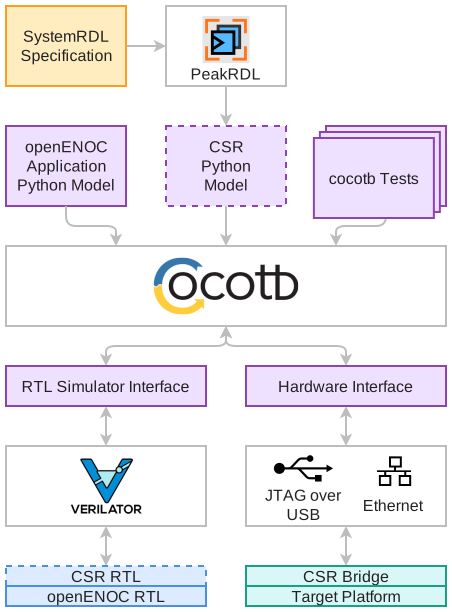
Control and Status Register (CSR) definitions are described using SystemRDL and serve as the single source of truth for register-level interfaces.
CSR-Based Verification Framework
PeakRDL-generated Python models are used within the verification environment to provide a consistent abstraction of the register map. This approach enables automated verification of control-plane functionality while ensuring alignment between RTL implementations, software APIs, documentation, and verification artefacts.
By deriving verification models directly from the SystemRDL specification, register-level tests can be developed independently of implementation details, reducing duplication and improving maintainability as the design evolves.
The generated CSR models also provide a common software interface that can be connected either to a simulated RTL environment or to physical hardware through the Hardware Interface abstraction layer. This enables the same verification software, configuration utilities, and diagnostic tools to be reused across simulation and hardware environments, minimizing differences between development and deployment workflows.
As a result, software-driven verification can be performed early in the development process using simulated hardware models and later reused for validation on FPGA-based platforms without significant modifications.
Full-endpoint CSR test backend
dv/hal/openenoc_endpoint_full/ exercises the generated CSR block through
AXI4-Lite. testbench.py starts a 10 ns clock, applies reset, and constructs
a cocotb AxiLiteMaster and the generated PeakRDL register model.
rtl_simulator.py implements the model’s synchronous read/write callbacks
with cocotb resume wrappers around asynchronous bus transactions. Cocotb
bridge runs the normal Python register tests from tests.py without
blocking the simulation event loop.
The RTL wrapper test_openenoc_endpoint_full_csr.sv injects hardware status
and command acknowledgements. The tests use generated register locations,
including configuration adjacency checks and independent peer/raw-DMA error
clear commands. The CSR block, its package, and the Python model come from
build/hal/openenoc_endpoint_full/; regenerate them with make -C hal all.
The simulation build and outputs go to
build/dv/hal/openenoc_endpoint_full/sim_build/.
This suite uses the cocotb Makefile flow directly. Verilator FST tracing is
enabled on each simulation run, and make wave in the suite directory opens
the dump.fst from that build directory with GTKWave. It has no pytest
parameter sweep. The component
suites use their run_tests.sh pytest, waves, and clean entry points.
All project DV suites store generated artifacts under build/dv/, mirroring
their source group and component names. Make uses sim_build/ and
pytest uses sim_build/pytest/<case>/ inside each component’s build directory.
Simulator binaries, generated C++ sources, result XML, FST waveforms, and
captured PCAP files stay there. Python bytecode uses the component’s
__pycache__/ prefix and temporary files use tmp/. The pytest session
cache is shared at build/dv/.pytest_cache/. These paths apply to direct
Make and pytest calls as well as the shell wrappers.
hardware_test.py reuses the same register tests and callback API through
HardwareInterface. The current backend is a placeholder based on the
generated simulator model, rather than board access. make hwtest selects
that backend. A board transport can replace its read/write implementation
without changing the register tests.
Traffic-Based Verification
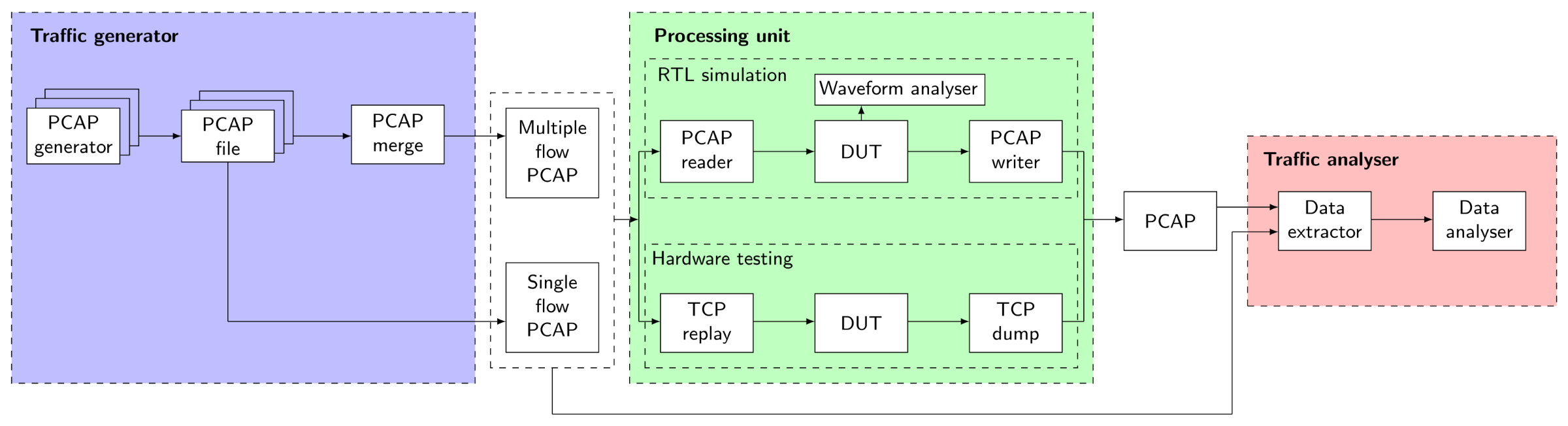
Since openENOC is built around Ethernet-based communication, the verification framework adopts a PCAP-based traffic methodology inspired by previous work on verification and benchmarking of networking and cryptographic hardware. In this approach, packet traces are used as reproducible test vectors that can be injected into both simulated and physical implementations.
Traffic-Based Verification Framework
Traffic stimuli are generated from recorded or synthesized Ethernet traces and injected into simulations through dedicated source models. Corresponding sink models capture resulting Ethernet frames and store them as PCAP files for post-processing and analysis. This approach is conceptually aligned with the PCAP reader and PCAP writer methodology, where network traffic is replayed through a device under test and captured again for functional and performance evaluation.
The use of PCAP files enables reproducible regression testing, reuse of real network traffic captures, protocol-level debugging, and integration with standard analysis tools such as Wireshark. Captured traces can be compared against reference outputs, enabling packet-level scoreboarding and protocol-aware verification. Furthermore, the same methodology can be applied in both RTL simulation and hardware-based testing environments, providing a consistent verification workflow throughout the project lifecycle.
Hardware-Software Co-Verification
Hardware-software co-verification validates hardware and software together as an interacting system. Software drives the hardware through its normal APIs, while the verification environment checks both software results and hardware responses to expose errors at their boundary.
Compiled C firmware executes on the PicoRV32 RTL processor within the Verilator
endpoint simulation, while cocotb controls stimuli and observes hardware
behavior. With runtime assertions enabled (DEBUG=1), a failed C assert
records the source-file pointer and line in _openenoc_assert_status,
publishes a failure status, and then traps the CPU, preserving the application’s
completed-check mask.
The full-endpoint suite includes continuous-transfer, stalled-transfer, and fault-injection scenarios that check both successful execution and the assertion failure path.
The linker keeps this record at the start of DMEM, and testbench signals expose its fields and the CPU trap to cocotb. Cocotb resolves the filename from the firmware image and reports the failing software check alongside observed traffic and bus activity; successful runs require firmware success, the expected completed-check mask, and the hardware checks. Fault-injection scenarios corrupt loopback payloads to verify that assertion diagnostics appear before the trap and remain intact afterward, as described by the assertion contract in Runtime assertions.
ISS-Based Co-Simulation
The implemented co-simulation environment in dv/iss/ executes RISC-V
firmware with Spike, the RISC-V ISA simulator, while Verilator simulates
the endpoint crossbar, DMEM, generated CSR block, communication logic, and
Ethernet streams. Cocotb drives the hardware, services software data accesses,
and checks firmware results together with bus and traffic behavior. This
complements the existing PicoRV32 RTL firmware tests with an ISS backend.
Spike is embedded through its processor_t and simif_t APIs behind a
versioned C ABI, accessed from Python through ctypes. Each endpoint handle
owns one RV32I+Zicsr machine-mode hart and one native worker thread. The worker
publishes one pending 1-, 2-, or 4-byte external data request and waits while
cocotb performs the corresponding AXI4-Lite transaction. Execution resumes
after the final R or B response, so backpressure reaches the executing firmware
while the simulator thread remains free to advance RTL and service other
endpoints. Independent workers run without an instruction-by-instruction host
barrier.
Memory ranges come from the RDL-generated
build/hal/<endpoint>/sw/memory_map.h and are passed per endpoint handle.
HAL_EP selects the default map, currently openenoc_endpoint_full. This
profile provides private 32 KiB ISS IMEM at 0x00000000, RTL DMEM at
0x10000000-0x10007fff, and RTL CSRs at 0x20000000-0x20001fff. Instruction
fetches stay in private ISS IMEM. Native tests qualify distinct maps in one
process; the current RTL test tops and firmware targets use the full endpoint.
Mixed RTL endpoint types require matching test tops, source selections, and
firmware builds.
The ELF loader validates ELF32 little-endian RISC-V executables against the RV32I soft-float profile, supported memory ranges, load-segment constraints, and an executable entry point. It copies file-backed load bytes into ISS IMEM using their physical/load addresses. Firmware startup copies initialized data to RTL DMEM and clears BSS; the loader leaves those operations to the actual startup code. ELF symbols provide completion addresses for the tests.
The unchanged csr_smoke C application runs with a separate PLATFORM=iss
rv32i_zicsr ELF, using standard machine-mode CSRs and mret in place of
PicoRV32-specific IRQ instructions. IRQ-enabled handles sample the actual RTL
CPU IRQ level into mip.MEIP and receive bounded instruction credit,
initially 32 steps per sampled RTL clock. After each AXI response, the bridge
publishes the stable IRQ level before releasing the blocked instruction.
This pacing is not a PicoRV32 cycle model; handles without IRQ support retain
unpaced execution.
The verification targets cover the native API, Python binding, ELF loader, and software interactions with RTL:
rtl-smoke,rtl-lanes-smoke, andrtl-bridge-smokeexercise DMEM accesses, byte/halfword lanes, signed loads, AXI channel backpressure, malformed requests, bus errors, and timeouts.rtl-firmware-smokecheckscsr_smokeinterrupt entry and return, both CSR claim completion tokens, IRQ assertion and deassertion, and the complete 17-beat Ethernet frame, includingTKEEPandTLAST.rtl-irq-system-smokeruns two independent IRQ-enabled instances with separate RTL loopbacks.rtl-startup-smokerunsiss_startupto check initialized data, dirty BSS clearing, read-only data, and stack traffic through RTL DMEM.rtl-system-smokeruns two independentiss_linkcontexts against directly crossed RTL Ethernet streams. It checks request/reply traffic, firmware-validated Ethernet headers and payloads, every transferred beat, isolated DMEM state, and continued progress while the other endpoint stalls or stops. A separate case checks recovery after a mid-frame stop.rtl-lifecycle-smokequalifies coordinated worker stop and whole-top RTL/BFM reset while AW/W, B, or R is blocked. Restarted workers use a new epoch, and late responses are rejected. An accepted write remains in DMEM; an incomplete write does not.
Malformed and out-of-range requests are rejected before AXI submission. CSR
generation enables --err-if-bad-addr and --err-if-bad-rw. The bridge
suite checks that an unassigned CSR read and a read-only CSR write return
RTL-generated SLVERR and report an error to the ISS worker. Separate error
and 10 us timeout tests use a controlled AXI responder. These checks do not
establish CPU trap equivalence or safe replay of an in-flight write after
timeout. Lifecycle recovery coordinates worker stop with bus reset. Recovery
from an interrupted Ethernet frame resets both endpoints and starts a fresh
exchange. The recorded
accepted_sim_tick marks submission to the AXI BFM, while
completed_sim_tick follows the R/B response.
make -C dv/iss check runs native and Python checks, and
make -C dv/iss check-all adds every RTL target and generates the aggregate
success manifest. Per-target JUnit XML and the validated JSON manifest live
under build/dv/iss/reports/. The manifest records repository and pinned
Spike commits, tracked-worktree state, ISS library and platform-specific
firmware hashes, CPU/memory/IRQ profile, tool versions, and test counts.
Missing or failing XML prevents manifest generation, and check-all removes
the previous manifest before starting. Standalone smoke targets do not update
that aggregate result. ThreadSanitizer qualification uses the separate
tsan-smoke target. Build prerequisites, individual commands, and clean-clone
qualification are documented in dv/iss/README.md; the pinned Spike commit
and CPU profile are recorded in dv/iss/compatibility.json.
Verification Roadmap
Further development will extend the existing component, endpoint, and two-endpoint ISS suites to larger integrated systems with switches and multiple clock domains. Software-driven Switch HAL verification, broader protocol-aware scoreboards, and systematic functional coverage collection will build on the current tests and firmware completed-check reporting.
The Spike bridge, ELF loading, standard machine-mode startup and interrupt support, and independent endpoint execution are implemented. Further ISS work will extend software scenarios and heterogeneous RTL endpoint configurations using per-instance memory maps and matching firmware builds.
Interactive debugging through GDB, OpenOCD, and development IDEs remains a future extension of the embedded Spike backend. It will require debugger transport and coordination of halt, resume, and stepping with cocotb and pending RTL transactions.
Project-wide regression coordination and automated verification in continuous
integration remain further infrastructure steps. These workflows will reuse
the existing suite entry points and ISS aggregate manifest, execute selected
configuration matrices, and collect results and coverage information to detect
regressions as the hardware and software evolve. ISS qualification includes a
post-commit clean-clone check-all run with
tracked_worktree_dirty: false in the manifest.
FPGA-based validation will follow by replacing the current simulator-backed hardware-interface placeholder with a real board transport. Reusing register tests, firmware, and traffic scenarios on physical hardware will extend verification to implementation timing, clock-domain interactions, and complete system integration.
Summary
The openENOC verification infrastructure combines component RTL tests, generated CSR models, PCAP traffic replay and capture, and full-endpoint hardware-software co-verification. Verilator and cocotb provide the common simulation environment, while parameterized regressions and shared artifact paths support reproducible execution and debugging.
Firmware running on the PicoRV32 RTL processor exercises the Endpoint HAL and reports assertion failures with source-file and line diagnostics, preserving completed-check information before trapping the CPU. Cocotb checks these software results together with hardware behavior, including backpressure and fault-injection scenarios.
The integrated Spike backend also runs compiled firmware against RTL peripherals through a threaded AXI4-Lite bridge. Its tests cover ELF startup, subword accesses, backpressure, standard machine-mode interrupts, independent two-endpoint execution, and coordinated stop/reset recovery. JUnit results and an aggregate manifest capture the qualified configuration and source state.
The next stages will expand integrated-system and software coverage, add interactive debugging of the embedded ISS, and coordinate verification regressions through continuous integration. A real hardware transport will later enable reuse of the verification workflows on FPGA platforms.