Forwarding engine – openenoc_axis_forwarding_engine
Determines Ethernet forwarding destinations and learns source addresses for received frames.
Source: openenoc_axis_forwarding_engine.sv.
Parameters
Name |
Default value |
Allowed values |
Description |
|---|---|---|---|
|
|
1..32 |
Port count and forwarding-bitmap width; both table interfaces use the same value. |
Signals
Interface ports contain channels in both directions. The table identifies the selected modport or stream role; member directions follow that interface.
Name |
Type |
Direction / role |
Description |
|---|---|---|---|
|
|
input |
Common clock for the frame stream and table interfaces. |
|
|
input |
Active-high synchronous reset of parsing, requests, and buffered data. |
|
|
input |
Requests a pause at the next frame boundary. |
|
|
output |
Indicates active frame and output pipeline have drained for pause. |
|
|
sink |
Complete frame bytes; TID identifies the ingress port. |
|
|
source |
Unchanged frame bytes; TUSER carries the egress-port bitmap. |
|
|
bidirectional (mst) |
Destination lookup request and returned forwarding bitmap. |
|
|
bidirectional (mst) |
Source-address learning request and acknowledgement. |
Architecture and operation
The engine extracts the first six valid frame bytes as the destination MAC and the next six as the source MAC. The first frame byte occupies the lowest byte lane of TDATA and the most significant byte of its 48-bit MAC address. The header stays in the frame: output data, KEEP, and LAST retain their input values. Input TID is captured with the first accepted beat for lookup and learning decisions, and should remain constant throughout that frame.
After accepting a complete destination address, the engine pulses
lookup_if.req for one cycle and waits for its acknowledgement. Input
READY is low during this wait, and no frame data is released. The returned
bitmap is masked to remove the ingress port:
egress_bitmap = lookup_if.port_bitmap & ~(1 << ingress_port).
The remaining source-address bytes are then accepted. A wide beat may
already contain the complete source address when lookup finishes.
Once all 12 address bytes are available, the engine pulses
learning_if.req with the source MAC and a one-hot ingress bitmap.
It waits for learning_if.ack before making the frame available at
m_axis. Each request payload remains stable while its acknowledgement
is pending. The learning request is generated even if the selected output
bitmap is zero; any managed-mode learning policy belongs to the table.
The table can connect directly or through
Forwarding-table request arbiter – openenoc_forwarding_table_arb_mux.
The header buffer is a chain of two-entry AXI-Stream register slices
(skid buffers), with ceil(12 / KEEP_W) slices. It retains the accepted
prefix while table operations are pending. Once learning completes, the
buffer drains and the remaining input bytes can enter. This is streaming
storage rather than a complete-frame FIFO. Input timing, table response
latency, and output readiness determine when buffered data is available.
The next frame cannot enter until the current output TLAST is accepted.
Every output beat carries the same egress bitmap in the low
NUM_OF_INTERFACES TUSER bits; any higher TUSER bits are zero.
Input TUSER is replaced, while TID and TDEST pass through with casts to
their output widths. Enabled STRB also follows the buffered data.
The egress bitmap is internal switch metadata and does not add frame bytes.
Data and metadata remain stable while output VALID is high and READY is low.
A zero egress bitmap does not suppress the output stream. The complete input
still leaves m_axis with TUSER zero; a downstream routing block decides
how to handle that bitmap. An input ending before six valid bytes produces
neither lookup nor learning. An input with a complete destination but fewer
than 12 valid bytes performs lookup but no learning. Both truncated cases
are released unchanged with a zero bitmap, without a separate error signal.
pause_request blocks the first beat of a new frame at a frame boundary.
A frame already admitted continues through lookup, learning, and output.
pause_done becomes high only after its output TLAST has transferred and
the header buffer and request strobes are idle. It stays high while the
request is held at that boundary. Removing pause_request permits the next
frame to enter. Reset abandons partial frames and pending operations; reset
must be coordinated with the attached table or arbiter.
Use byte-granular DATA widths from 8 through 512 bits, with
KEEP_W = DATA_W / 8 and matching input/output DATA, KEEP, and KEEP-enable
settings. Both streams require LAST and ID. Input ID must encode all port
indices, and output USER must be enabled and at least
NUM_OF_INTERFACES bits wide. Use ingress indices in
0 .. NUM_OF_INTERFACES - 1. Non-final beats have all KEEP bits set;
a partial final beat uses contiguous valid low byte lanes. The parser does
not validate Ethernet length, EtherType, FCS, or sparse KEEP patterns.
Functional scenarios
The examples use NUM_OF_INTERFACES = 4, 64-bit input/output DATA,
KEEP_W = 8, enabled KEEP, LAST, and ID, and four output USER bits.
The engine connects directly to an unmanaged Forwarding table – openenoc_forwarding_table
with eight entries. Reset and initial table setup have already completed.
All interfaces share a 10 ns clock.
A0 and A1 are distinct destination MACs, while A2 and A3
are their corresponding source MACs. Initial table entries map
A0 to 0b1110 and A1 to 0b0100. Port bit n selects
port n. TUSER and table-interface bitmaps show all four bits in port
order [3:0]. The source presents each queued input continuously while
it is waiting for acceptance.
FA uses data labels DA0, DA1, and subsequent beats; FB
uses DB0, DB1, and subsequent beats. Labels stay the same at the
input and output. Each complete 66-byte Ethernet frame includes its Ethernet
header and excludes preamble, SFD, and FCS. It has eight full beats with
KEEP 0xFF and one final two-byte beat with KEEP 0x03 and TLAST.
The deliberately truncated inputs below are not complete Ethernet frames.
A numbered tick marks a clock interval. A beat transfers at its ending
rising edge when VALID and READY are high. Requests and acknowledgements
are sampled at the same edge. x marks irrelevant payload outside an
active stream beat, request, or acknowledgement.
Destination lookup, source learning, and ingress exclusion
Frame |
Length |
Destination / source |
Ingress |
Lookup / output bitmap |
|---|---|---|---|---|
|
66 bytes |
|
Port 1 |
|
DA0 transfers in tick 1 and contains all six destination bytes plus
the first two source bytes. Lookup requests A0 in tick 2; its
acknowledgement in tick 4 returns 0b1110. Removing ingress port 1
leaves 0b1100. Input DA1 transfers in tick 5 and completes the
source address. Learning requests A2/0b0010 in tick 6 and completes
in tick 8.
Output starts in tick 9, with TUSER 0b1100 on every beat. DA0 through
DA8 leave consecutively in ticks 9 through 17, while the remaining
input data enters behind the buffered prefix. The output preserves both
address fields and the final two-byte KEEP mask.
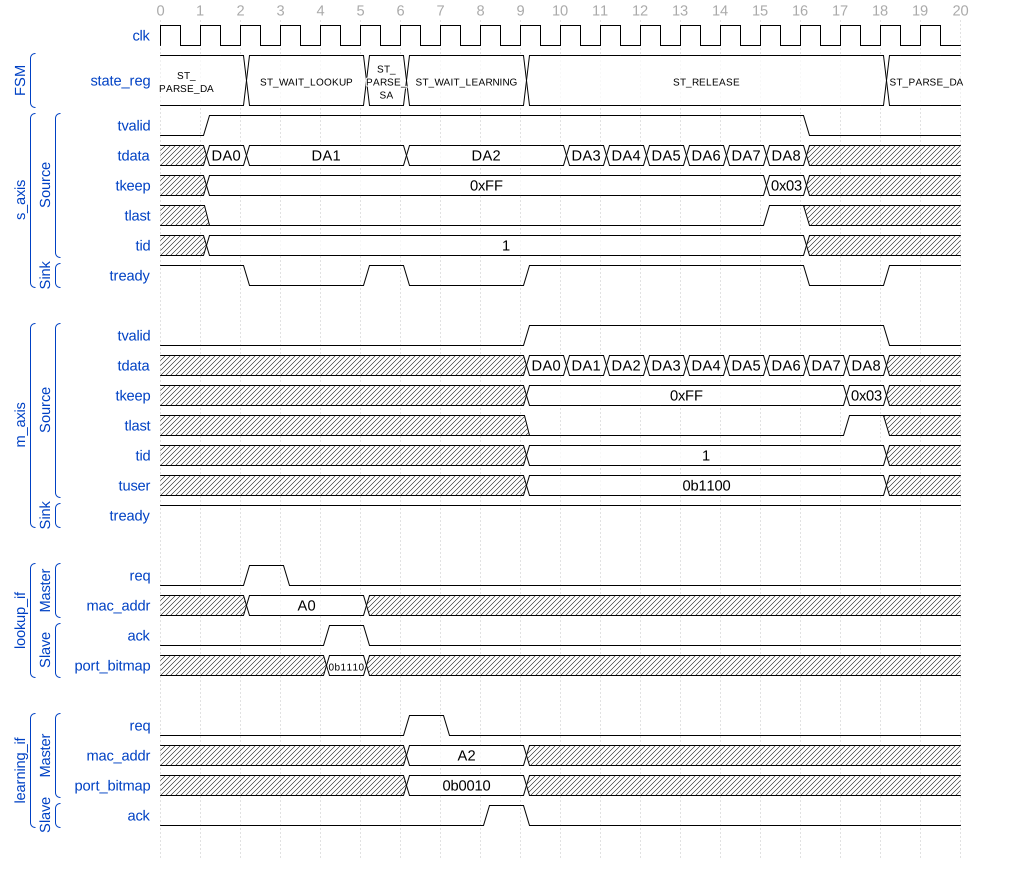
Lookup and learning complete before the unchanged frame is released
Incomplete destination and source addresses
Input |
Length |
Data beats |
Address bytes present |
Table operations |
|---|---|---|---|---|
|
5 bytes |
|
Incomplete destination |
None |
|
9 bytes |
|
Complete |
Lookup only |
The five-byte DA0 transfers in tick 1 with KEEP 0x1F and TLAST.
It leaves in tick 3 with TUSER zero, without any table request.
The next input starts with DB0 in tick 4. Its complete destination
A1 produces the lookup pulse in tick 5 and response 0b0100 in tick 7.
DB1 then transfers in tick 8 with KEEP 0x01 and TLAST, before
all source bytes have arrived. Both output beats carry TUSER zero in
ticks 9 and 10, and learning remains inactive.
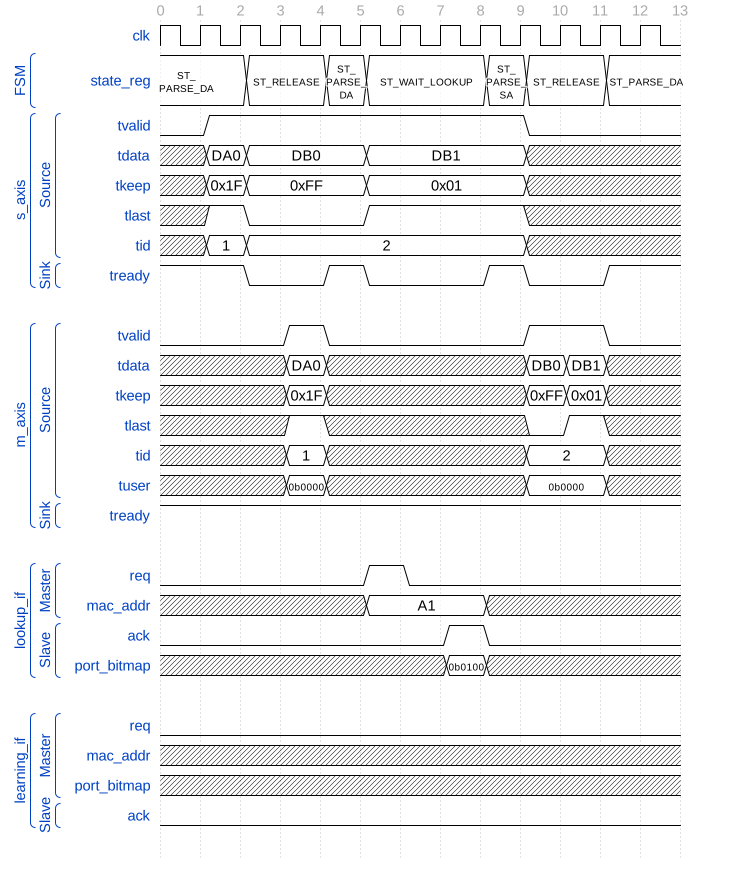
Truncated address fields suppress learning and select a zero bitmap
Frame-boundary pause, drain, and resume
Frame |
Length |
Destination / source |
Ingress |
Lookup / output bitmap |
|---|---|---|---|---|
|
66 bytes |
|
Port 1 |
|
|
66 bytes |
|
Port 2 |
|
pause_request rises in tick 12 while FA is in progress. The engine
continues accepting its remaining beats; DA8 enters in tick 15.
Although DB0 is already offered from tick 16, it cannot enter yet.
Output READY is low in ticks 17 through 20, holding the final DA8
beat with KEEP 0x03, TLAST, and TUSER 0b1100 unchanged. pause_done
stays low until this beat transfers in tick 21, then rises in tick 22.
The two diagrams show consecutive clock intervals.
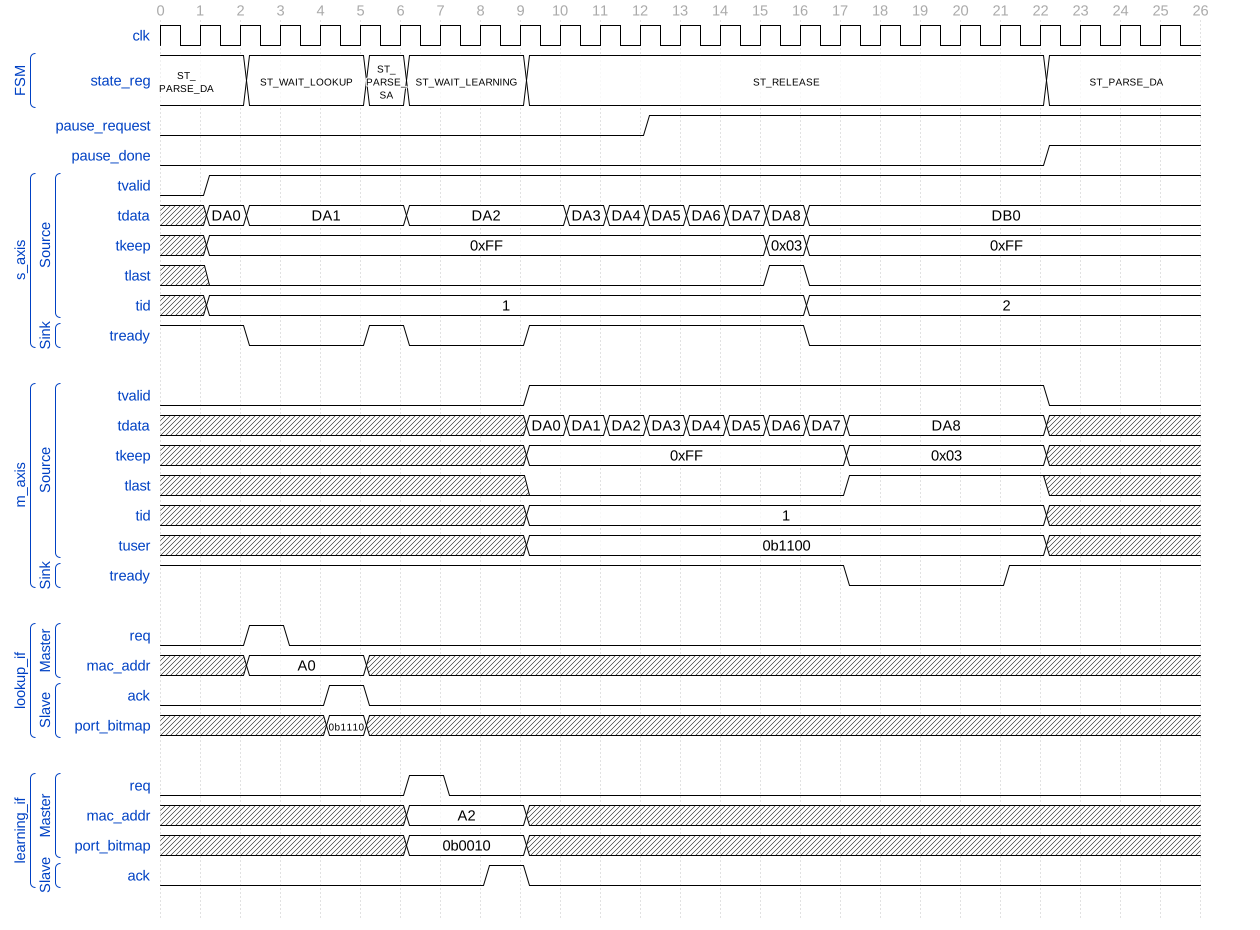
Pause waits for the final output handshake before completing
With pause_request still high, pause_done remains high and
DB0 remains pending. Removing the request in tick 31 permits that
beat to transfer. Lookup for A1 runs from the request in tick 32
to acknowledgement in tick 34; learning A3/0b0100 runs from tick 36
to tick 38. Output FB then occupies ticks 39 through 47.
The lookup bitmap 0b0100 contains only FB’s ingress port. Excluding it
leaves zero, but source learning still completes and every frame beat
is emitted with TUSER zero. Its final DB8 transfers once, in tick 47,
with KEEP 0x03 and TLAST.
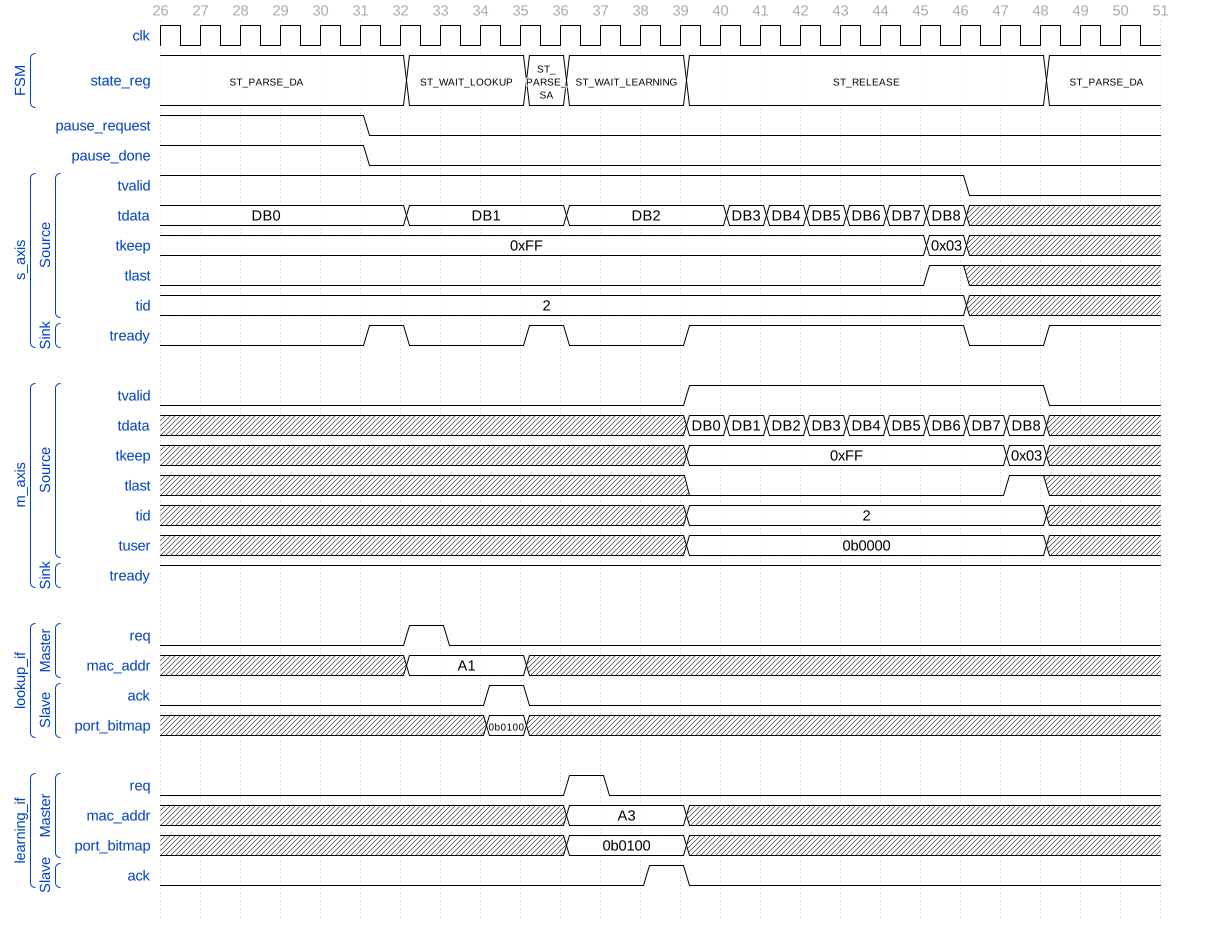
The next frame resumes after pause and retains its zero egress bitmap
Verification
The test suite is in dv/core/openenoc_axis_forwarding_engine/.
Testbench
This test suite validates the openenoc_axis_forwarding_engine module, which parses the
destination and source MAC addresses from each AXI Stream frame and connects the stream data
path to the lookup and learning interfaces of the openENOC forwarding table.
The forwarding table is not instantiated. Its lookup and learning interfaces are driven by a behavioral model in the Python testbench so that the forwarding engine can be verified stand-alone.
The engine starts a lookup as soon as the six-byte destination MAC address is complete. Source-address learning starts only after the destination lookup has been acknowledged and the complete six-byte source MAC address has arrived. If the source MAC is already present in a wide input beat, learning starts as soon as the lookup completes; otherwise, the engine resumes parsing until the source MAC is complete and then issues the learning request. Destination lookup and source-address learning both apply backpressure as needed, and the buffered frame is released only after all forwarding-table transactions associated with its header have been acknowledged. This ordering prevents the next frame from starting a new lookup while learning for the current frame is still pending on the table’s shared internal arbitration path.
The lookup result is attached to the released frame on m_axis.tuser. The ingress interface
index is carried on s_axis.tid and is removed from the egress bitmap to prevent forwarding a
frame back to its source interface.
AXI Stream Input Contract
The MAC parser expects canonical packet-oriented tkeep usage:
Every beat except the final beat of a frame must have all byte lanes valid.
On the final beat (
tlast = 1), valid bytes must be contiguous from the least-significant byte lane. Gaps intkeepare not supported.When
KEEP_ENis disabled, every byte lane is treated as valid.
The byte-counting and MAC-address extraction logic relies on this contract. Frames with sparse
tkeep, or with invalid lanes before valid lanes, are outside the supported input format.
Forwarding Table Model
The testbench implements the openENOC request/acknowledge handshake. The engine asserts
lookup_if.req or learning_if.req for one clock cycle and keeps the associated payload
stable while it waits. The model returns a single-cycle acknowledge after a configurable
latency. During each wait, the testbench checks that the input is stalled and no buffered output
beat is released.
Known destination MAC addresses are resolved using the model’s entry map. A lookup miss returns the configured default forwarding bitmap. Every accepted lookup and learning request is recorded and checked for correct ordering and contents.
Coverage
Functional checks:
Destination and source MAC extraction across different AXI Stream widths
Lookup hit and miss handling
Ingress interface removal from the forwarding bitmap
Correct learning MAC address and one-hot ingress interface bitmap
Frame payload integrity and
tid/tdestpass-throughForwarding bitmap alignment on
m_axis.tuserZero forwarding bitmap with no lookup or learning for incomplete 1-5 byte destination addresses
Zero forwarding bitmap and no learning for incomplete 6-11 byte headers
Input stalling while lookup and learning acknowledgements are pending
Stable request payloads throughout configurable acknowledgement latency
Directed scenarios:
test_incomplete_destination_address_sets_zero_bitmap: frames ending before the complete six-byte destination address are released withtuser = 0and do not generate lookup or learning requests.test_incomplete_source_address_sets_zero_bitmap: frames containing a complete six-byte destination address but an incomplete source address are released withtuser = 0and do not generate learning requests.
Scenarios (TestFactory):
Back-to-back frames with known and unknown destination MAC addresses
Frame lengths of 32, 60, 79, and 128 bytes
Idle insertion and output backpressure combinations
Lookup and learning acknowledgement latencies of 2, 4, and 256 cycles
Parameter sweep (pytest):
DATA_Win {8, 16, 24, 64, 128, 512}