Shared-bus switch – openenoc_eth_switch_shared_bus
Switches Ethernet traffic through one shared forwarding pipeline.
Source: openenoc_eth_switch_shared_bus.sv.
Parameters
Name |
Default value |
Allowed values |
Description |
|---|---|---|---|
|
|
2..32 |
Number of Ethernet ports and forwarding-bitmap width; match the switch interface. |
|
|
Integer >= 1 |
Number of forwarding-table entries. |
|
|
8..512 bits, multiple of 8 in forwarding integration |
Internal switching stream width; link/fabric widths must have an integer ratio. |
|
|
NUM_OF_INTERFACES-bit mask |
Port orientation: zero is side A, one is side B. |
|
|
Bytes; >= 2 widest-side words, power-of-two word count |
Per-port asynchronous FIFO capacity; divisible by the widest link/fabric word size. |
Signals
Interface ports contain channels in both directions. The table identifies the selected modport or stream role; member directions follow that interface.
Name |
Type |
Direction / role |
Description |
|---|---|---|---|
|
|
input |
Clock for this component or interface domain. |
|
|
input |
Active-high reset of transaction and control state. |
|
|
bidirectional (core) |
Switch configuration, pause status, and forwarding-table CPU access. |
eth_if[NUM_OF_INTERFACES-1:0] |
|
bidirectional; PORT_SIDE per port |
Per-port bidirectional links, each with its own clock/reset domain. |
Architecture and operation

Shared-bus Ethernet switch architecture
Ingress adapters feed a shared stream multiplexer. One
Forwarding engine – openenoc_axis_forwarding_engine performs destination lookup and source
learning through one Forwarding table – openenoc_forwarding_table. A bitmap-controlled demux
replicates or drops the resulting frame at the egress boundary. Ingress
identity accompanies the stream for learning and ingress-port exclusion.
The ingress multiplexer arbitrates complete frames, so all inputs share one
internal path even when their destinations differ. The forwarding engine puts
the selected egress-port bitmap in internal TUSER; Stream demultiplexer – openenoc_axis_demux
uses it for unicast delivery or multicast fanout.
Multicast fanout applies all-or-none backpressure to the selected outputs. Once a selected egress FIFO cannot accept another beat, the shared path stalls. This can delay unrelated ingress traffic as well as the current frame. A multicast beat advances only when all selected outputs can accept it.
The fabric uses clk/rst while each Ethernet port retains its own domain.
Pause control takes effect at a frame boundary through the forwarding engine.
Parameter meanings and port orientation follow Switch architecture selector – openenoc_eth_switch.
Functional scenarios
These examples use NUM_OF_INTERFACES = 4, TABLE_DEPTH = 8,
FABRIC_DATA_W = 64, and four 64-bit Ethernet links with KEEP_W = 8,
KEEP_EN = 1, and LAST_EN = 1. The fabric and all four link clocks
have aligned rising edges and a 10 ns period. Resets have been released,
and managed forwarding entries are already configured; there is no
concurrent CPU table access.
With PORT_SIDE = 0b1111, frames enter through
eth_if[n].a2b_axis_if and leave through eth_if[n].b2a_axis_if.
All example frames contain 66 bytes, including the Ethernet header and
excluding preamble, SFD, and FCS. Each frame uses eight full beats with
KEEP 0xFF and a final two-byte beat with KEEP 0x03 and TLAST.
Data labels identify the frame: FA uses DA0 through DA8,
FB uses DB0 through DB8, FC uses DC0 through DC8,
and FD uses DD0 through DD8. Each frame retains its prefix
on every link and multicast copy, with beat numbering restarting at zero.
All scenarios use PORT_FIFO_DEPTH = 128 except the blocked
multicast scenario, which uses PORT_FIFO_DEPTH = 32.
A numbered tick marks a clock interval. A beat transfers at the ending
rising edge when VALID and READY are both high. x denotes irrelevant
values while VALID is low.
The matching Crossbar switch – openenoc_eth_switch_crossbar examples use the same frames, routes, clocks, FIFO capacities, and receiver readiness.
Disjoint unicast routes
Frame |
Data beats |
Ingress |
Egress |
|---|---|---|---|
|
|
Port 0 |
Port 2 |
|
|
Port 1 |
Port 3 |
|
|
Port 2 |
Port 0 |
|
|
Port 3 |
Port 1 |
All four ingress sources assert VALID at tick 1 and send their complete
frames without input stalls. Every egress receiver stays ready. In the
illustrated arbitration state, the shared ingress multiplexer selects
FD, then FC, FB, and FA. Their output transfers occupy
ticks 22–30 on port 1, 39–47 on port 0, 56–64 on port 3, and
73–81 on port 2. The shared forwarding pipeline serializes all four
frames even though their destinations are distinct. The initial winner
can change with round-robin history.
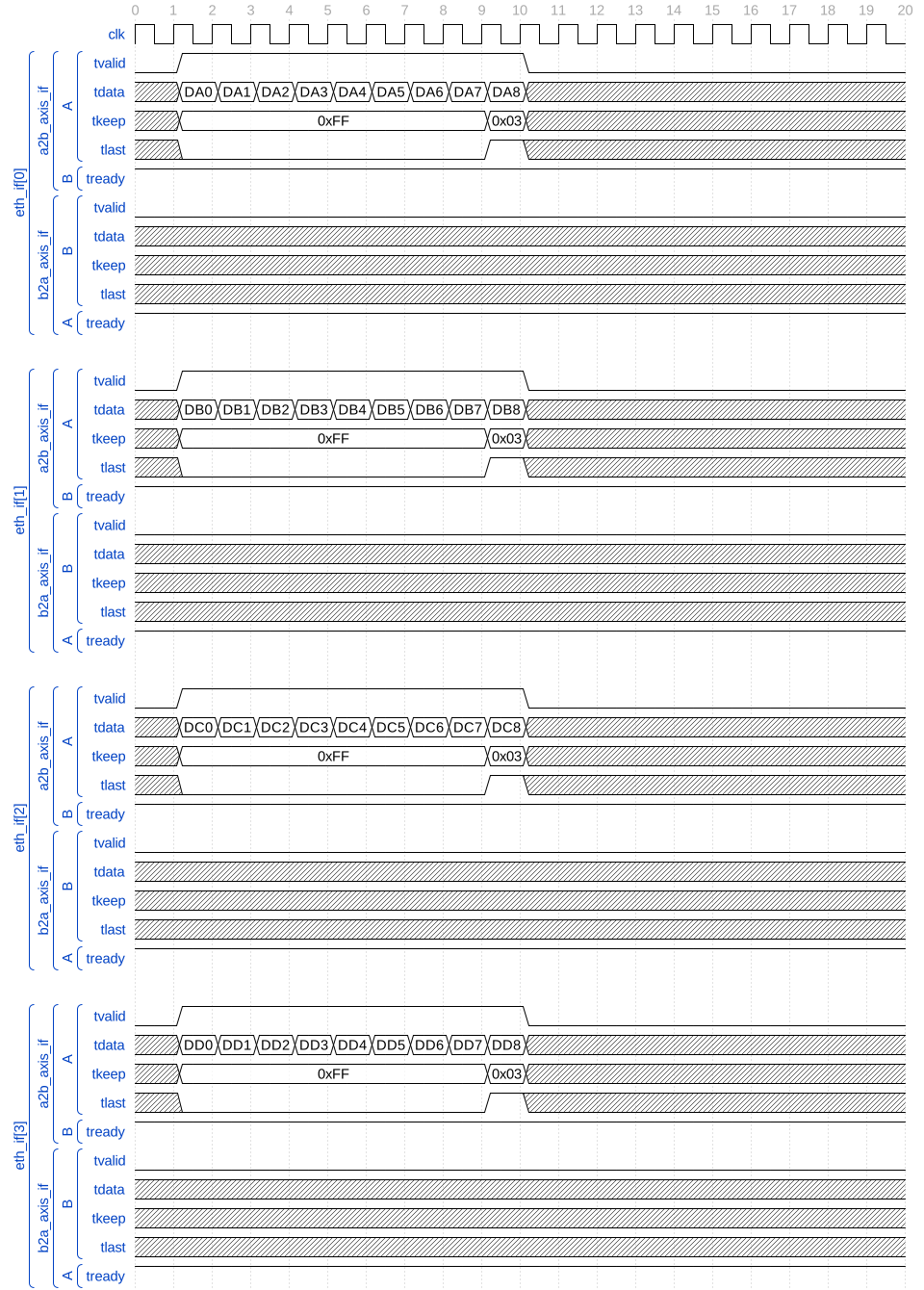
Four frames enter the four-port switch concurrently
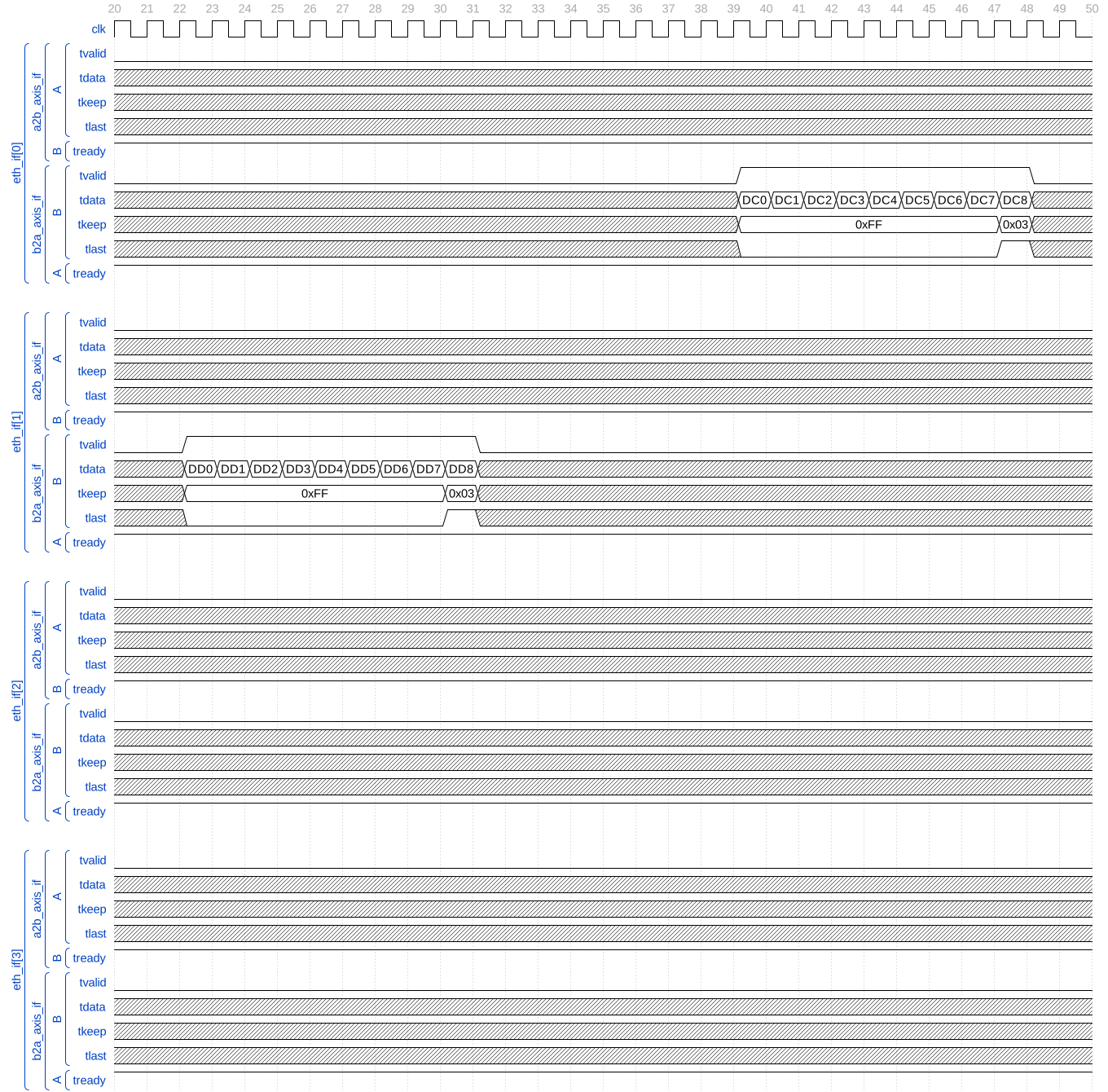
First two disjoint unicast frames leave through the shared path
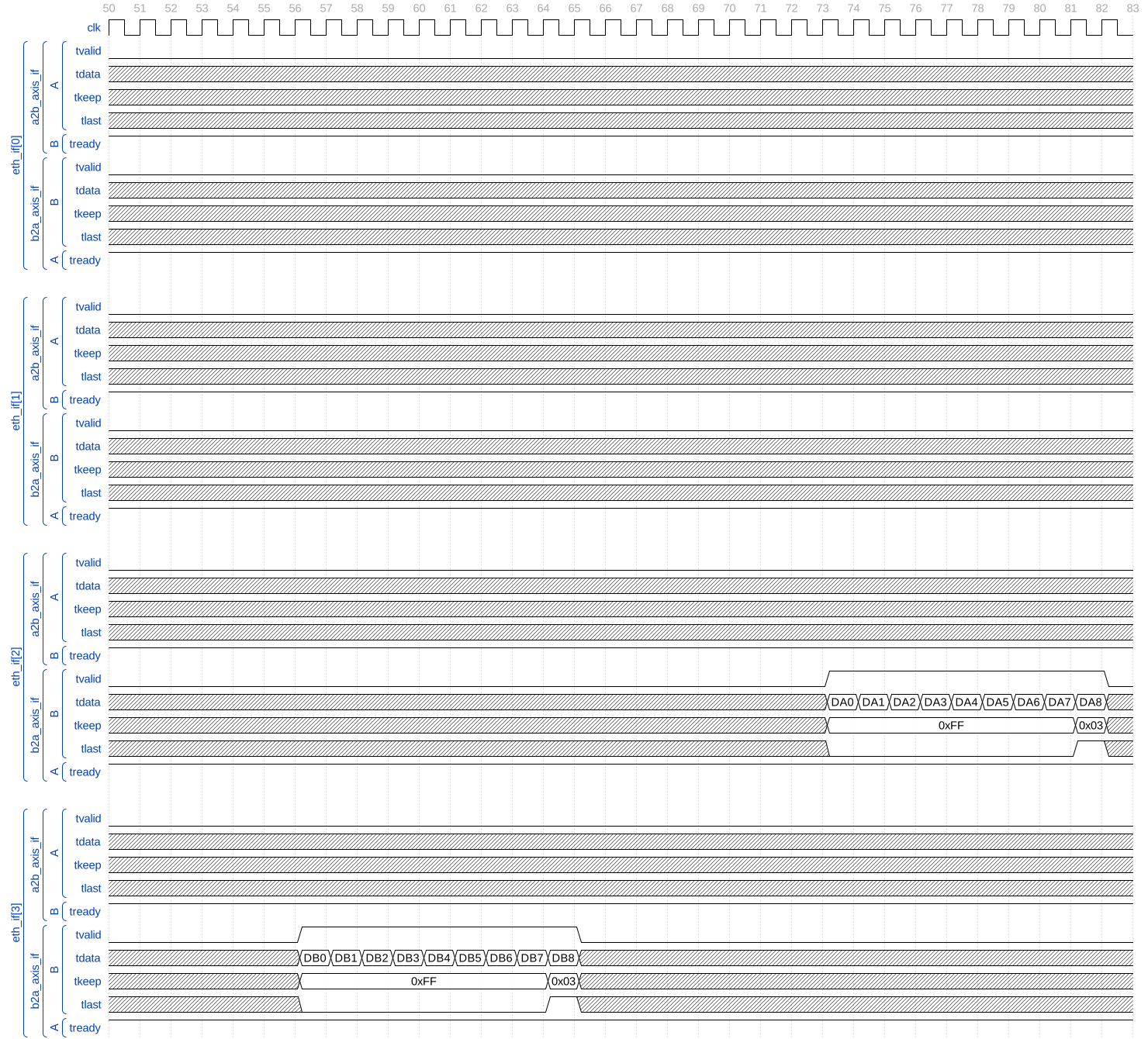
Remaining disjoint unicast frames leave through the shared path
Contention for one output
Frame |
Data beats |
Ingress |
Egress |
|---|---|---|---|
|
|
Port 0 |
Port 3 |
|
|
Port 1 |
Port 3 |
Here FA and FB enter ports 0 and 1 at tick 1, with both
destination entries selecting port 3. Its receiver stays ready. The shared pipeline forwards FB
and then FA, preserving each complete frame on the output. Other
ports receive neither frame. Compared with
Contention for one output, the shared ingress path determines
the order before the frames reach the egress FIFO.
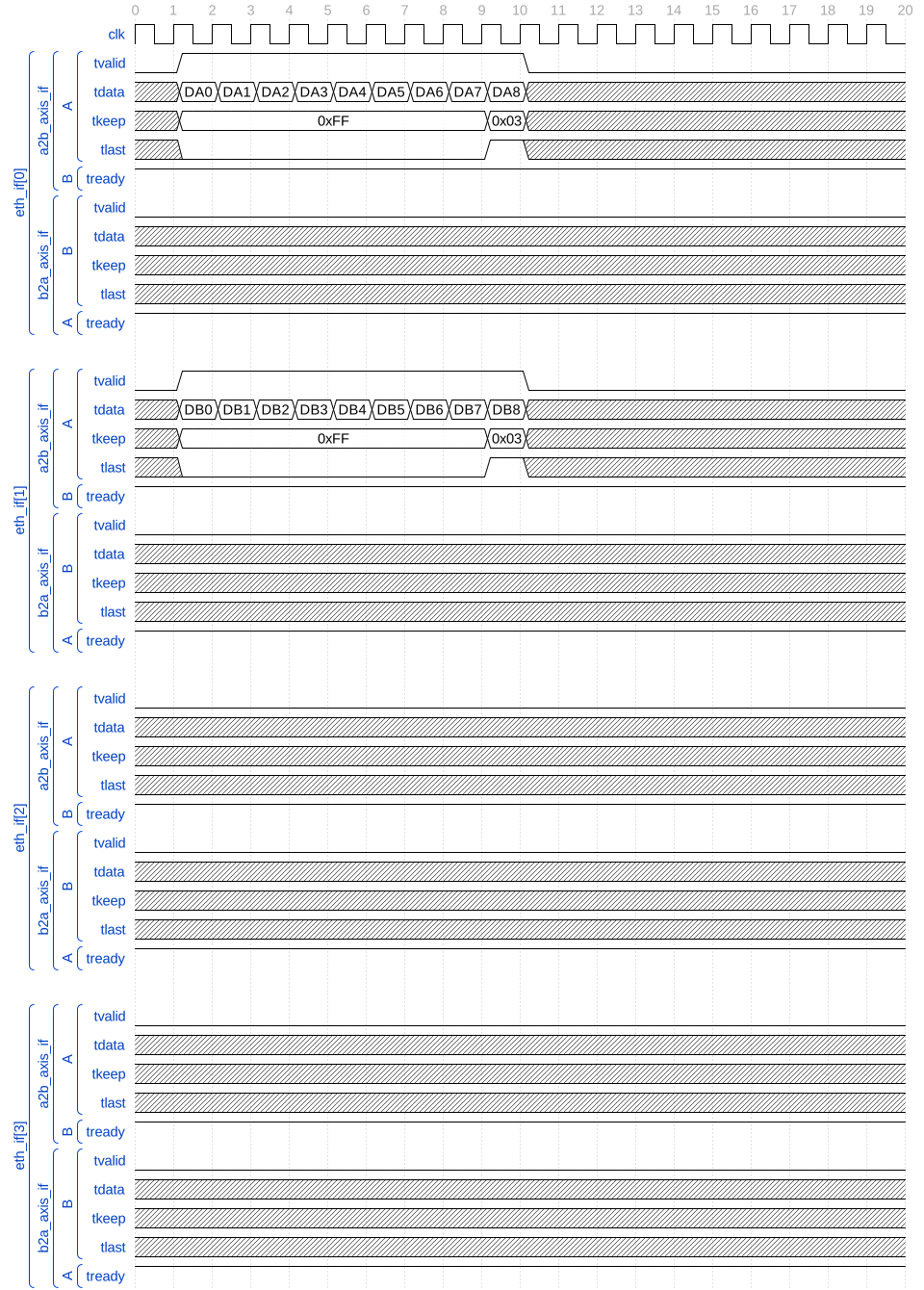
Both frames enter the four-port switch
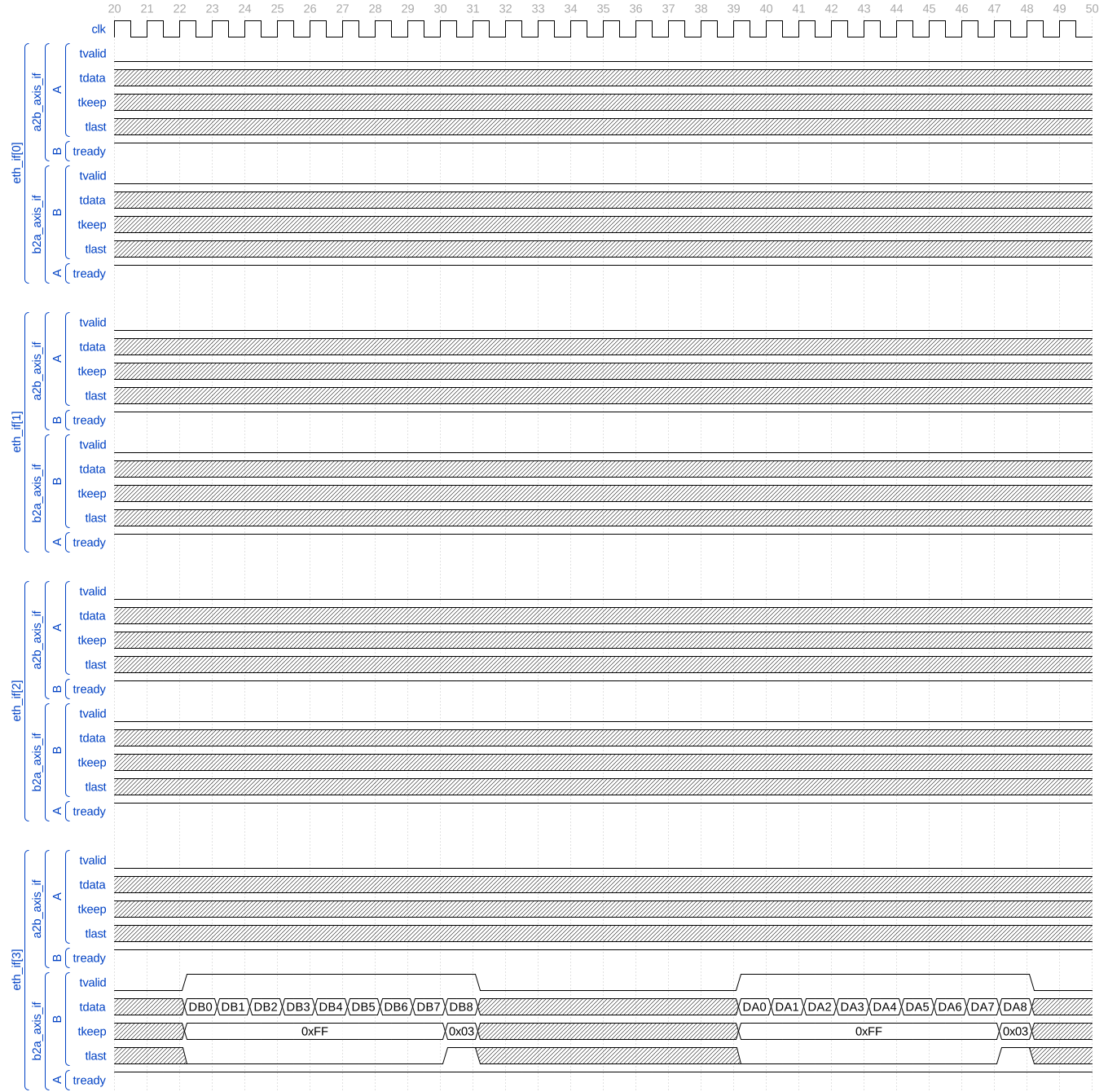
Two complete frames share port 3 without beat interleaving
Broadcast without stalls
Frame |
Data beats |
Ingress |
Egress |
|---|---|---|---|
|
|
Port 0 |
Ports 1, 2, and 3 |
The managed forwarding entry for destination FF:FF:FF:FF:FF:FF
selects bitmap 0b1111. The forwarding engine excludes ingress
port 0, so the broadcast frame reaches ports 1, 2, and 3. All receivers
remain ready.
FA enters port 0 in ticks 1–9. Its three copies transfer
concurrently in ticks 22–30, with the same DA0 through DA8
on every output. Each copy ends with KEEP 0x03 and TLAST;
no copy returns to the ingress port.
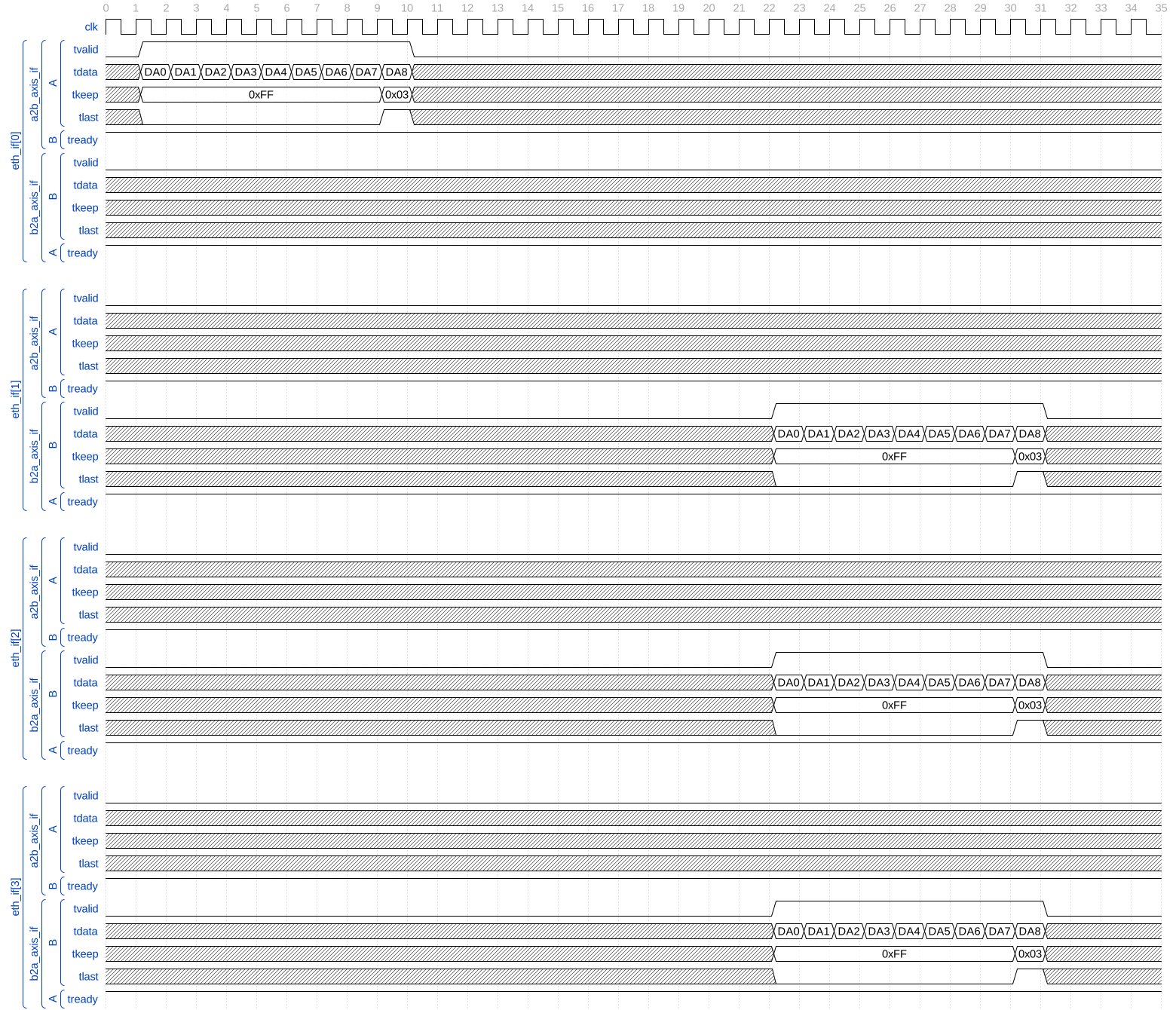
One 66-byte broadcast frame is replicated to every other port
Blocked multicast and a disjoint route
Frame |
Data beats |
Ingress |
Egress |
|---|---|---|---|
|
|
Port 0 |
Ports 2 and 3 |
|
|
Port 1 |
Port 0 |
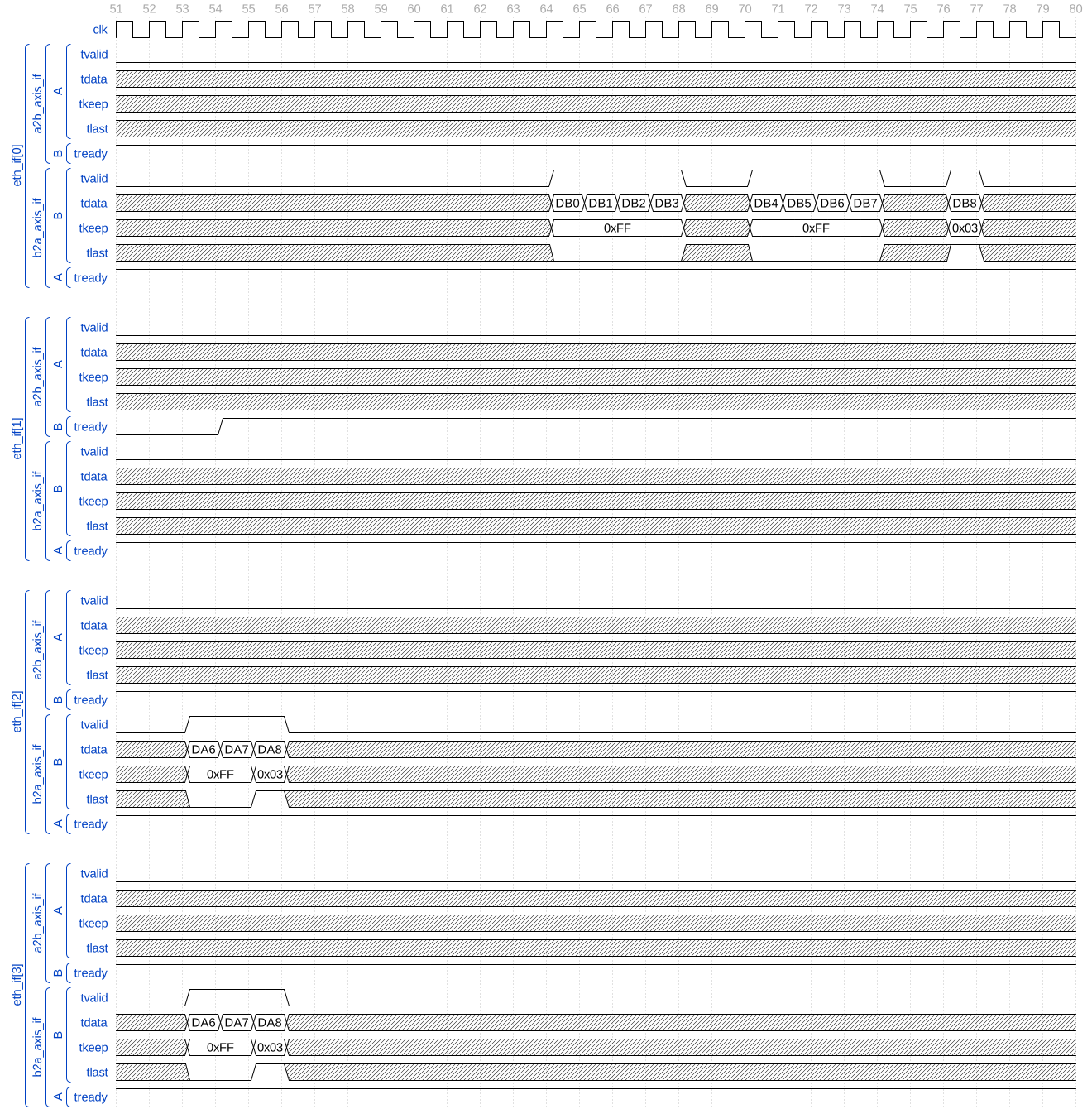
FA starts at tick 1 and selects ports 2 and 3. FB starts at
tick 5 and selects port 0. Port 3 holds READY low until tick 45;
ports 0 and 2 remain ready. PORT_FIFO_DEPTH = 32 makes the selected output FIFO fill
before the complete multicast frame can enter it. The small streaming
FIFOs also expose gaps between bursts as data and space availability
cross the clock-domain boundaries.
The egress FIFOs allow port 2 to deliver a prefix of FA while
port 3 holds DA0. Once port 3’s FIFO fills, all-or-none multicast
backpressure stops the shared forwarding path. FB cannot pass that
frame, so port 0 remains idle despite being ready. In the
Blocked multicast and a disjoint route example, the same independent route
can progress during this interval.
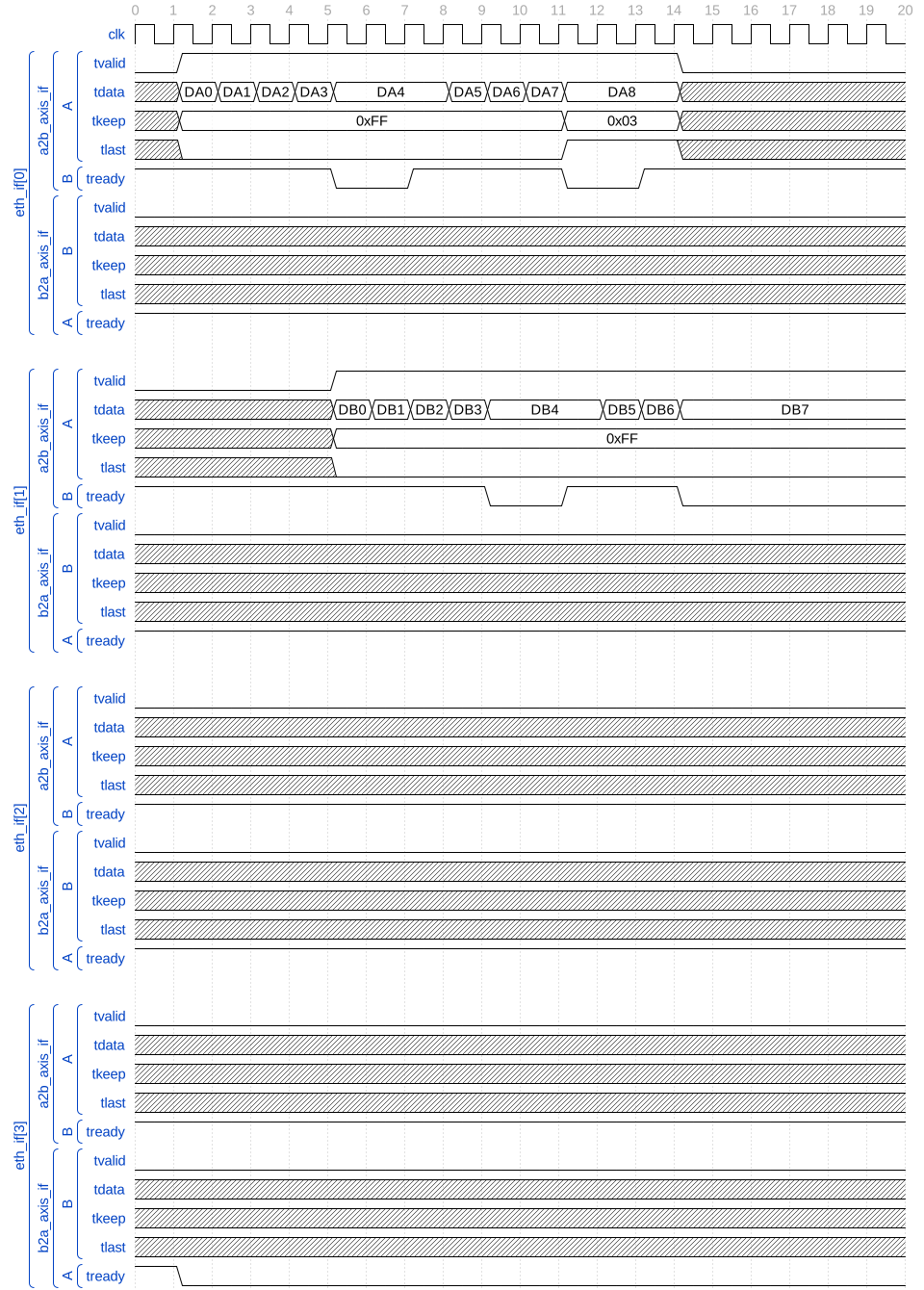
Multicast and disjoint unicast frames enter the four-port switch
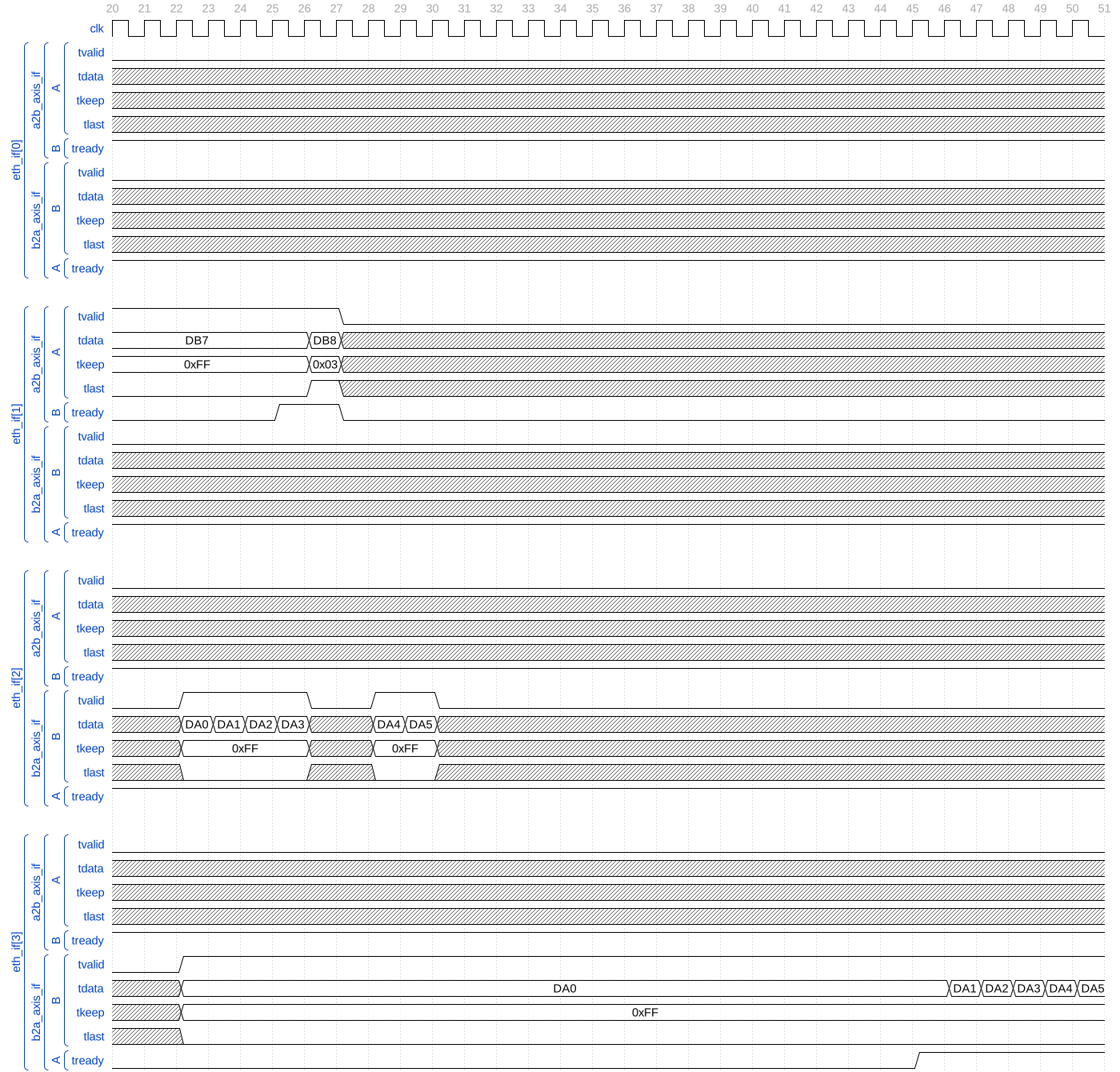
Blocked multicast delays the disjoint unicast route
After port 3 asserts READY, its FIFO drains and the remaining
multicast beats reach both destinations. Only then can the shared
forwarding engine release FB toward port 0. Both multicast copies
end with DA8, and the later unicast ends with DB8; each final
beat has KEEP 0x03 and TLAST.
Multicast completion releases the waiting unicast frame
CSR-controlled pause and resume
Frame |
Data beats |
Ingress |
Egress |
|---|---|---|---|
|
|
Port 0 |
Port 1 |
|
|
Port 1 |
Port 0 |
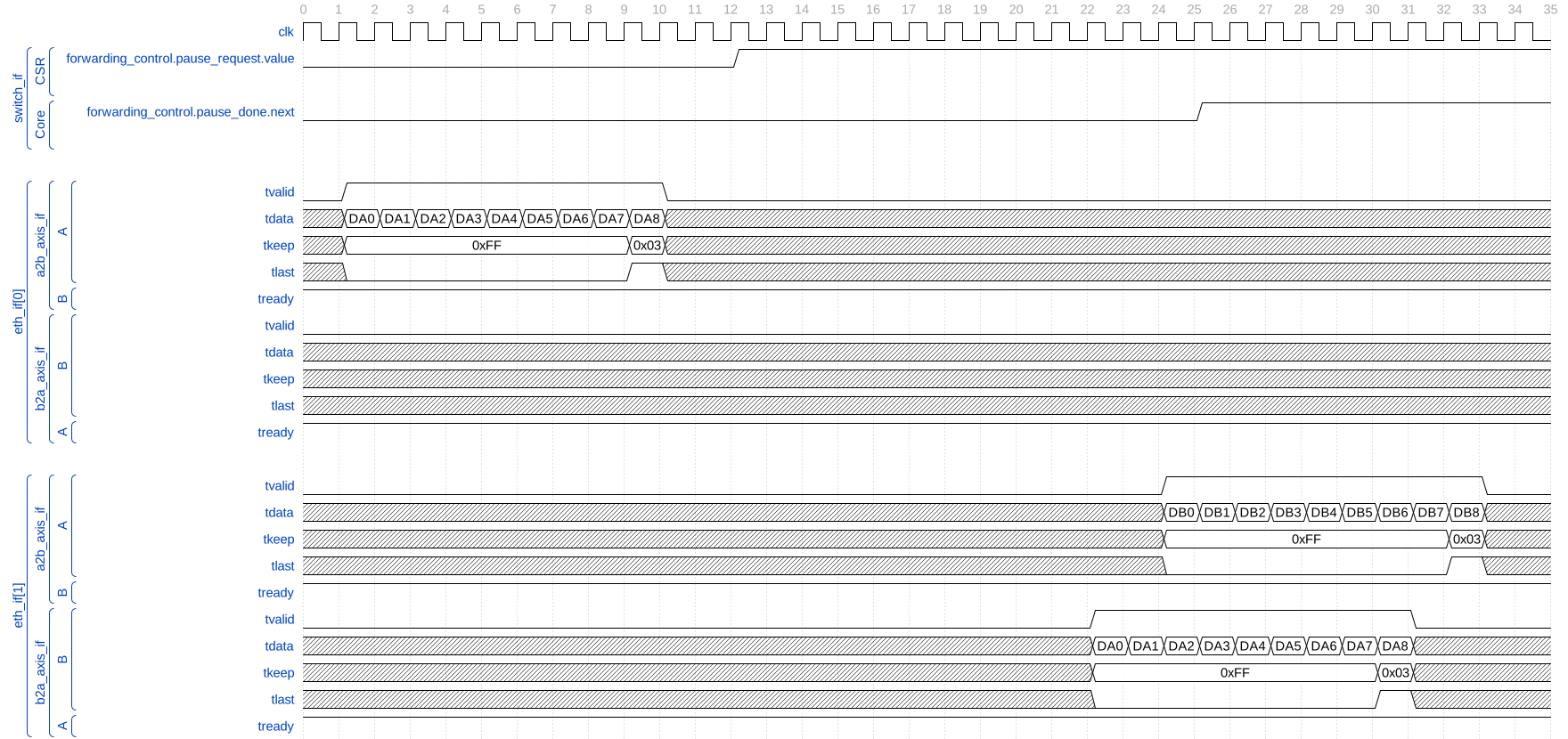
FA arrives in ticks 1–9 and forwarding begins. A CSR write
sets forwarding_control.pause_request at tick 12. The pause
request allows the active frame to finish before stopping at the
next frame boundary. Every receiver remains ready.
FB arrives on the reverse route in ticks 24–32 while port 1
finishes transmitting FA in ticks 22–30. Input buffering
accepts the second frame, which waits for forwarding while the
pause request remains asserted.
forwarding_control.pause_done becomes high at tick 25, confirming
that forwarding is paused at frame boundaries. Egress FIFOs can
continue draining after this status rises.
CSR pause lets FA finish while FB waits for forwarding
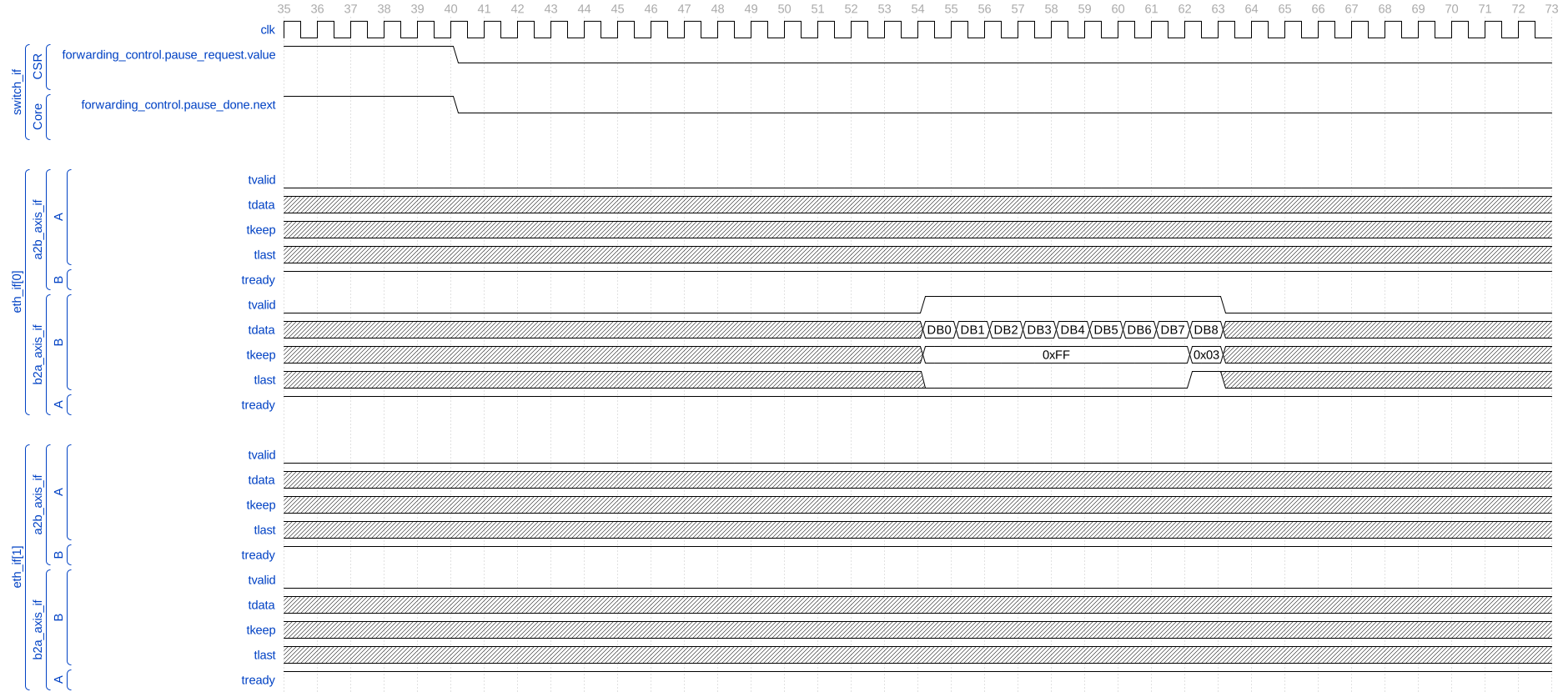
A CSR write clears pause_request at tick 40. pause_done
falls, and the queued reverse frame can proceed. Port 0 transfers
DB0 through DB8 in ticks 54–62, ending with KEEP
0x03 and TLAST. No beat of FB leaves the switch before
the pause is released.
Clearing the CSR pause forwards the queued reverse frame
Verification
The test suite is in dv/core/openenoc_eth_switch_shared_bus/.
Testbench
This integration suite validates the openenoc_eth_switch_shared_bus module. The switch
combines per-port clock-domain and data-width adapters, a frame-aware round-robin AXI Stream
arbiter/multiplexer, the openENOC forwarding engine and forwarding table, and a bitmap-routed
AXI Stream demultiplexer.
The test wrapper instantiates the switch, a parameterized array of openenoc_eth_if links,
and one openenoc_switch_if. The default Makefile configuration uses four links. The
generated CSR register block is intentionally not instantiated. Flattened testbench signals
drive the control fields of openenoc_switch_if directly from cocotb and expose the
corresponding status and acknowledge signals.
The wrapper acts as the peer opposite each switch port. For a side-B switch port it transmits
through a2b_axis_if and receives through b2a_axis_if; those directions are reversed for
a side-A switch port. Constant-index AXI Stream bridges expose both cases uniformly as
port_rx_axis_if and port_tx_axis_if. This also avoids unreliable VPI access to nested
interface arrays with Verilator.
Datapath Under Test
For each input frame, the test exercises the complete shared datapath:
The ingress asynchronous FIFO adapter moves the frame into the fabric clock domain and adapts it to
FABRIC_DATA_W.taxi_axis_arb_muxselects one ingress using frame-aware round-robin arbitration and writes the selected port index intotid.openenoc_axis_forwarding_engineextracts the destination and source MAC addresses, requests lookup and learning operations, removes the ingress port from the forwarding result, and writes the egress bitmap intotuser.openenoc_forwarding_tablereturns either a matching table bitmap or the configured default bitmap. In unmanaged mode it also learns source MAC addresses automatically.openenoc_axis_demuxuses thetuserbitmap to replicate the frame to all selected outputs with all-or-none multicast backpressure.The egress asynchronous FIFO adapters return the frames to the individual port clock domains.
Control Interface Model
The wrapper exposes the following CSR-equivalent controls to cocotb:
managed or unmanaged operation mode,
pause request and pause-done status,
default forwarding bitmap,
forwarding-table CPU address, write data, bit enables, request, and acknowledge signals.
Each forwarding-table entry occupies 16 bytes and contains four 32-bit words:
Word |
Byte offset |
Contents |
|---|---|---|
MAC low |
0 |
MAC address bits 31:0 |
MAC high |
4 |
MAC address bits 47:32 |
Interface bitmap |
8 |
Egress-port bitmap |
Configuration |
12 |
Entry-enable bit |
The managed-mode tests assert pause_request and wait for pause_done before programming
the table. This models the intended software sequence and ensures that modification occurs at a
frame boundary.
Coverage
Functional checks:
End-to-end frame transfer through ingress adaptation, arbitration, forwarding, demultiplexing, and egress adaptation
Lookup misses using the CSR default-forwarding bitmap
Managed forwarding-table programming through the CPU request/acknowledge interface
Lookup hits and multicast replication
Autonomous source-MAC learning in unmanaged mode
Removal of the ingress interface from the egress bitmap
Preservation of frame data and
tdestContinuous
tvalidacross back-to-back frame boundariesStandard 1500-byte and jumbo 9000-byte Ethernet payloads
Dropping frames with incomplete 1-5 byte destination addresses
Dropping frames with incomplete 6-11 byte Ethernet headers
Detection of frames delivered to unexpected egress ports
Pause request and pause-done sequencing before managed table updates
Pause requests asserted while a frame is active
CPU readback through the switch CSR bridge
Side-A, side-B, and mixed port orientations
Scenarios:
test_default_forwarding: an unknown destination arriving on port 0 uses default bitmap0b0010and exits only through port 1.test_managed_multicast_hit: software programs a destination with bitmap0b1100; the matching frame is replicated to ports 2 and 3.test_unmanaged_learning: a source observed on port 0 is learned and then reached by a frame arriving on port 1.test_ingress_port_suppression: a table result selecting ports 0 and 1 is reduced to port 1 when the frame arrived on port 0.test_arbiter_overwrites_source_tid: a frame carrying an intentionally incorrect sourcetidenters physical port 2; the arbiter replaces it with 2, forwarding suppresses port 2, and every output copy carriestid = 2.test_round_robin_between_active_ingresses: ports 0 and 1 are filled while forwarding is paused; after resume, frame-boundary observations verify that both active inputs are served alternately and that each frame retains the arbiter-generated ingress identity.test_zero_bitmap_drops_frame: an unknown destination with a zero default bitmap is consumed without appearing on any egress interface.test_incomplete_destination_address_drops_frame: frames ending before the complete six-byte destination address are dropped even when the default forwarding bitmap selects a valid egress.test_incomplete_ethernet_header_drops_frame: frames with a complete destination address but an incomplete source address are dropped even when the destination has a valid programmed unicast route.test_header_only_and_unaligned_frames: Ethernet header-only frames and several non-word-aligned lengths verify final-beattkeephandling.test_back_to_back_frame_burst: twelve consecutive frames of different lengths verify boundaries, ordering, sidebands, and sustained operation.test_no_idle_cycle_between_back_to_back_frames: four queued frames verify that the source presents the next frame in the cycle immediately following each acceptedtlast, without a source-created idle cycle.test_standard_and_jumbo_payloads: frames carrying 1500-byte and 9000-byte payloads with EtherType0x88B5traverse the switch intact. Their internal AXI Stream lengths are 1514 and 9014 bytes because FCS is not present.test_all_ingress_ports_simultaneously: all four ingress FIFOs are preloaded with three frames; each arbitration round must serve every port once, and all twelve frames must reach their independently configured outputs.test_unmanaged_mac_moves_to_new_port: a learned source moves from port 0 to port 2, and a subsequent lookup must use the updated location.test_multicast_with_output_backpressure: eight multicast frames traverse two independently stalled outputs without loss, duplication, or reordering.test_managed_table_cpu_readback: the highest valid table entry is written and all four CSR words are read back through the switch interface.test_pause_completes_current_frame_and_blocks_next: pause is asserted after arbitration starts a long frame; that frame drains, the next frame remains blocked, and forwarding resumes only after pause is released.
TestFactory matrix:
run_factory_routing follows the same factory pattern used by the other openENOC and Taxi
component tests. It generates the Cartesian product of:
three routes: unicast, two-port multicast, and all-port multicast with ingress suppression,
AXI input idle insertion disabled or enabled,
AXI output backpressure disabled or enabled.
Every generated case sends Ethernet frames with payload lengths 0, 1, 3, 16, 47, and 128 bytes.
It checks payload ordering and integrity, tid replacement, tdest preservation, multicast
copies, and absence of traffic on unselected ports.
Pytest parameter sweep:
The pytest runner repeats all 18 directed tests and 12 TestFactory cases for the following
(NUM_OF_INTERFACES, DATA_W, FABRIC_DATA_W, TABLE_DEPTH, PORT_FIFO_DEPTH, PORT_SIDE) tuples:
(4, 8, 32, 5, 64, 0b1111)(5, 24, 48, 8, 48, 0b10101)(4, 32, 32, 8, 64, 0b0000)(8, 64, 16, 8, 16, 0b10101010)
This covers four, five, and eight interfaces; width expansion, equal-width transfer, and width contraction; power-of-two and non-power-of-two stream widths; a non-power-of-two forwarding-table depth; a minimum-size two-word FIFO; and all-A, all-B, and mixed port orientations.
Independent port clocks, heterogeneous widths between ports, TABLE_DEPTH=1, and table-full
replacement behavior are not yet covered by this suite.