Endpoint interface – openenoc_endpoint_interface
Integrates endpoint transport, memory access, direct software streams, peer lookup, and interrupts.
Source:
openenoc_endpoint_interface.sv.
Parameters
Name |
Default value |
Allowed values |
Description |
|---|---|---|---|
|
|
Bytes >= MAX_RAW_FRAME_SIZE |
Capacity of each direct/DMA transport FIFO; supports one maximum raw frame. |
|
|
Integer >= 0 |
RAM pipeline stages in the transport FIFO adapters. |
|
|
Integer >= 1 |
Number of interrupt claims; power-of-two depth is not required. |
|
|
36..8192 bytes |
Synthesized frame ceiling excluding FCS; reserves 32 bytes for the largest peer-frame overhead. |
|
|
Integer >= 1 |
Number of local fragment bookkeeping contexts; not wire credits. |
Signals
Interface ports contain channels in both directions. The table identifies the selected modport or stream role; member directions follow that interface.
Name |
Type |
Direction / role |
Description |
|---|---|---|---|
|
|
input |
Clock for this component or interface domain. |
|
|
input |
Active-high reset of transaction and control state. |
|
|
bidirectional (core) |
Endpoint configuration, commands, status, and external scalar-memory access. |
|
|
bidirectional; endpoint is side A |
Ethernet frame transport; this endpoint is side A. |
|
|
bidirectional (wr_mst) |
Outgoing AXI4 memory write address/data/response channels. |
|
|
bidirectional (rd_mst) |
Outgoing AXI4 memory read address/response channels. |
|
|
bidirectional (mst) |
Local scalar-memory master supplied by the DMA engine. |
|
|
output |
Level interrupt notification to software. |
Architecture and operation

Internal structure of the openENOC Endpoint Interface
This single-clock integration module connects the generated endpoint_if
to the bidirectional eth_if, AXI memory masters m_axi_wr/m_axi_rd,
local-memory CPUIF master m_rmem_cpuif, and irq. Each submodule owns
its corresponding hardware-driven CSR fields.
The CSR block and AXI4-Lite adapters above the outlined endpoint are external
integration context. This module connects to the generated CSR interface and
the native local-memory CPUIF; it has no AXI4-Lite slave port.
endpoint_if.csr_to_core carries configuration and software commands,
while endpoint_if.core_to_csr carries hardware status and command clears.
The DMA Engine – openenoc_endpoint_dma_engine owns memory access and transfer contexts; oETP Engine – openenoc_endpoint_oetp_engine owns Ethernet protocol processing; Direct AXIS over CSR – openenoc_endpoint_direct_axis bridges the direct CSR stream; and Peer-table lookup – openenoc_endpoint_peer_lookup supplies both engines with peer snapshots. The IRQ controller – openenoc_endpoint_irq_controller collects the resulting notifications.
Two peer lookup clients serve DMA and oETP. Two transfer interfaces distinguish initiator and responder commands. TX/RX FIFOs, stream adapters, a TX mux, and an RX demux connect DMA and direct traffic to oETP. Internal FIFOs use streaming operation without frame-drop policies. Endpoint route/sequence/role metadata is kept inside the endpoint and cleared at the Ethernet boundary.
Seven IRQ producer ports carry three DMA events, two direct-stream events,
initiating RMEM errors, and received-request errors. The last port shares the
bulk/RMEM source encodings; port count and logical event count are distinct.
rst clears the submodules and FIFOs in this clock domain.
The TX mux uses round-robin arbitration at frame boundaries. DMA peer commands are sequential; protocol TX gives ready responses priority and RMEM initiation precedes the next bulk fragment. DMA owns memory operations and bulk/RMEM error status and notifications. Direct-stream notifications belong to the direct CSR stream block, while IRQ claim/status fields belong to the IRQ controller. The initiating RMEM error producer captures its source enable before any delayed IRQ admission.
FIFO_DEPTH specifies bytes for each transport FIFO, and
FIFO_RAM_PIPELINE sets its RAM pipeline stages. These FIFOs use
FRAME_FIFO = 0, DROP_BAD_FRAME = 0, DROP_WHEN_FULL = 0,
DROP_OVERSIZE_FRAME = 0, and MARK_WHEN_FULL = 0. They propagate
backpressure and permit streaming before a complete frame is buffered.
All AXI and AXI-Stream data paths are fixed at 32 bits, including the direct
CSR streams, DMA streams, and Ethernet streams. Internal
TUSER[0] denotes the final fragment and TUSER[1] distinguishes initiator
and responder payloads, as specified in DMA and RMEM Transfer Interface – openenoc_dma_transfer_if.
The AXI read and write ports and eth_if must use 32-bit data widths;
elaboration checks reject other widths. AXI and local RMEM CPUIF byte addresses
are fixed at 32 bits, with elaboration checks on the connected interfaces.
The local RMEM CPUIF transfers 32-bit words.
Functional scenarios
The examples assume valid peer windows and enabled operation classes.
A0/A1 denote addresses, D0/D1 scalar data, M0 a
per-bit write mask, I0 a peer index, and S0/S1 local
fragment sequences. Labels are local to each diagram.
CSR trace labels use register field paths relative to endpoint_if,
with the generated .value and .next wrappers omitted.
.hwclr denotes the hardware acknowledgement of a software command.
For rmem, the CSR side drives csr_to_core.rmem and the
core returns core_to_csr.rmem.
clk is the common endpoint clock. Numbered intervals end at the
rising edge that samples their values. Diagrams containing | omit
variable lookup, memory, FIFO, or network waiting time and show transaction
ordering without absolute cycle numbers. Their duration depends on the
connected logic and the remote peer.
Direct CSR frame transmit and receive
Software supplies a 64-byte frame through axis_if.source and reads
a simultaneously received 65-byte frame through axis_if.sink.
The direct path uses the TX/RX FIFOs and the shared oETP connection;
its payload bytes are preserved. In this example, no raw RX DMA descriptor
is armed, and the receive-mode filter accepts the incoming frame.
The Ethernet view uses DATA_W = 32 and KEEP_W = 4.
This endpoint is side A: DA0 through DA15 travel toward
the switch, while DB0 through DB16 arrive from it.
Frame lengths exclude preamble, SFD, and FCS.
The TX FIFO already contains the frame at the start of the example, and
DA0 waits for downstream readiness. TX stalls in cycles 5 and 6,
retaining DA3, full KEEP, and tlast = 0. The internal raw-frame
forwarding sequence also introduces TX idle intervals and applies RX
backpressure while classifying and forwarding the incoming frame.
The incoming source holds each stalled beat and keeps VALID asserted.
The gap omits TX transfers DA6 through DA12 and RX transfers
DB6 through DB12. TX finishes on DA15 with full KEEP and
TLAST. RX finishes on DB16 with tkeep = 0x1 and tlast = 1.
All earlier RX beats and all TX beats use tkeep = 0xF.
Endpoint routing metadata stays inside the module.
A direct RX notification is generated when the first received word becomes visible to software, so it may precede the rest of the frame. Direct TX completion is measured at the final handoff to the oETP input, after the FIFO/mux pipeline; it does not acknowledge receipt at the remote endpoint. The CSR word handshakes are described in Direct AXIS over CSR – openenoc_endpoint_direct_axis.
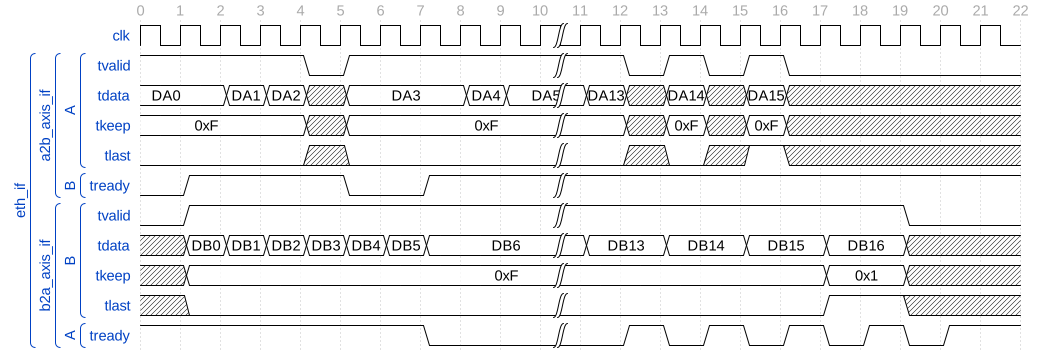
Direct 64-byte transmit and 65-byte receive at the endpoint Ethernet boundary
Raw DMA and sequential peer fragments
For raw TX, software provides a local buffer address and frame length in
non_oetp_dma.tx, then sets its request field. DMA reads that
buffer through m_axi_rd; the frame passes through the DMA TX FIFO
and shared TX mux. A raw RX descriptor armed in non_oetp_dma.rx
instead directs one eligible received frame through the DMA RX FIFO to
m_axi_wr. An accepted raw frame without an armed descriptor uses
the direct CSR sink. Filtering precedes descriptor ownership.
For peer DMA, configure a 65-byte block with a 64-byte fragment limit.
The initiator path below issues two bulk writes to peer I0:
64 bytes at A0 with sequence S0, followed by one byte at
A1 = A0 + 64 with sequence S1. The operation is
DMA_OP_WRITE, and the kind is TRANSFER_KIND_DMA.
Assume the corresponding local memory work finishes before each protocol completion. The second command remains unissued until the first fragment has completed locally and remotely. Only the second command and completion carry LAST. Completion of the final fragment sets the peer’s successful done state and, when enabled, produces one block-completion notification. The block keeps its accepted peer configuration and fragment-size snapshot.
Software starts the block through peers.entry[I0].dma.request;
request.hwclr acknowledges its acceptance and idle falls.
The peer becomes idle and reports done only after the final fragment’s
matching completion.
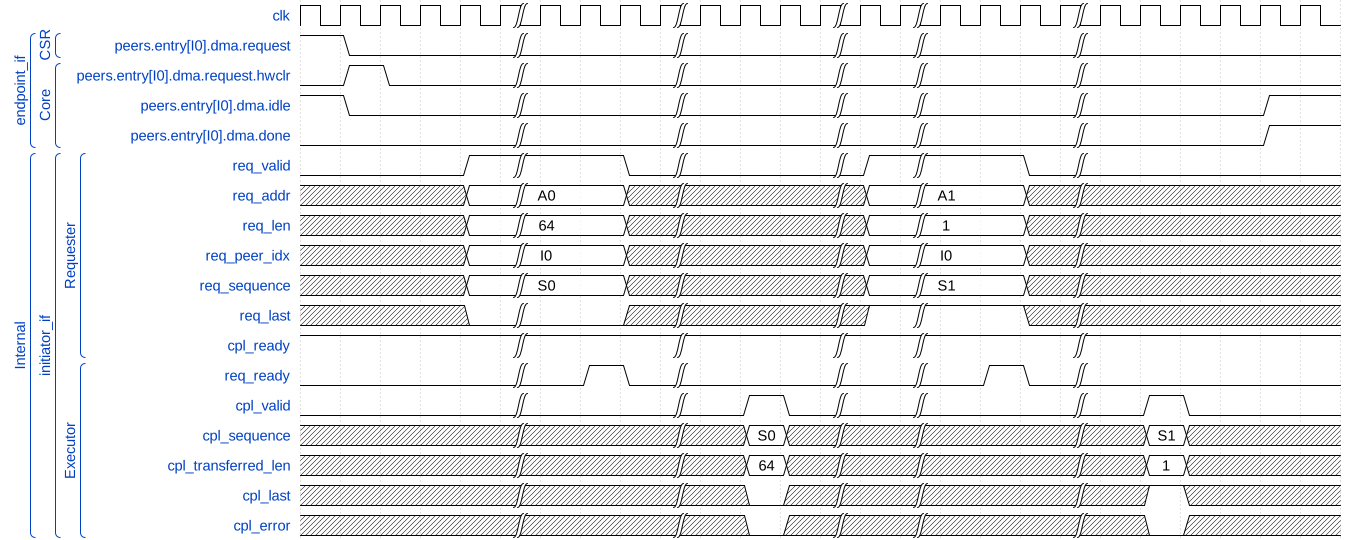
Sequential peer fragments joined with their matching protocol completions
Locally initiated RMEM read
A pulse on endpoint_if.csr_to_core.rmem.req starts a local
scalar access to a configured remote window. The endpoint captures
rmem.addr = A0 and rmem.req_is_wr = 0 at the rising edge that
accepts rmem.req. These request fields are needed only during that
request cycle; the following x regions mark irrelevant values.
Peer lookup translates the captured virtual address A0 to remote
address A1. The endpoint sends
RMEM_READ_REQ with A1 and wire Request ID RID0 through
eth_if.a2b_axis_if. The matching RMEM_READ_RSP arrives through
eth_if.b2a_axis_if with the same Request ID and scalar data D0.
The wait between the request and response includes variable network
transit and remote servicing time.
After accepting and validating the complete response, the endpoint returns
D0 with a one-cycle rmem.rd_ack pulse. This external window uses
ACK-only completion.
Both RMEM examples use DATA_W = 32 and KEEP_W = 4. The endpoint
is side A: DA words are transmitted and DB words are received.
Each illustrated frame includes its Ethernet header and the complete oETP
PDU, without external-MAC padding. Lengths exclude preamble, SFD, and FCS.
Every beat is full, with tkeep = 0xF; tlast marks its final word.
The read request and response are each 24 bytes:
Word index |
Transmitted request |
Received response |
|---|---|---|
0..2 |
|
|
3 |
|
|
4 |
|
|
5 |
|
|
A pending initiating RMEM access is selected before the next unsent bulk fragment, while an already advertised or active fragment finishes first.
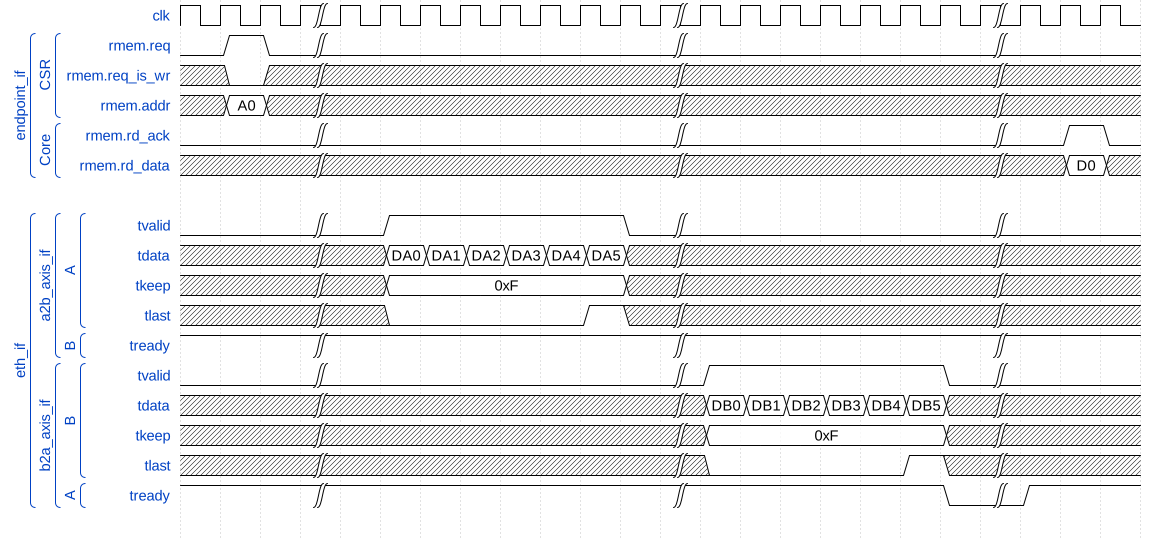
Local RMEM read sends an Ethernet request and completes from its response
Incoming RMEM write through local CPUIF
The endpoint receives a 32-byte unicast RMEM_WRITE_REQ through
eth_if.b2a_axis_if. After frame validation and peer lookup, it issues
a one-cycle request through m_rmem_cpuif with the received final local
address A0, write data D0, and mask M0. For example,
M0 = 0x0000000F enables bits 3:0.
A successful local write ACK allows the endpoint to transmit a 20-byte
RMEM_WRITE_RSP through eth_if.a2b_axis_if with the request’s
original RID0. The response is sent after local completion.
Successful zero-mask writes complete without issuing a local CPUIF request.
Word index |
Received request |
Transmitted response |
|---|---|---|
0..2 |
|
|
3 |
|
|
4 |
|
|
5 |
|
– |
6 |
|
– |
7 |
|
– |
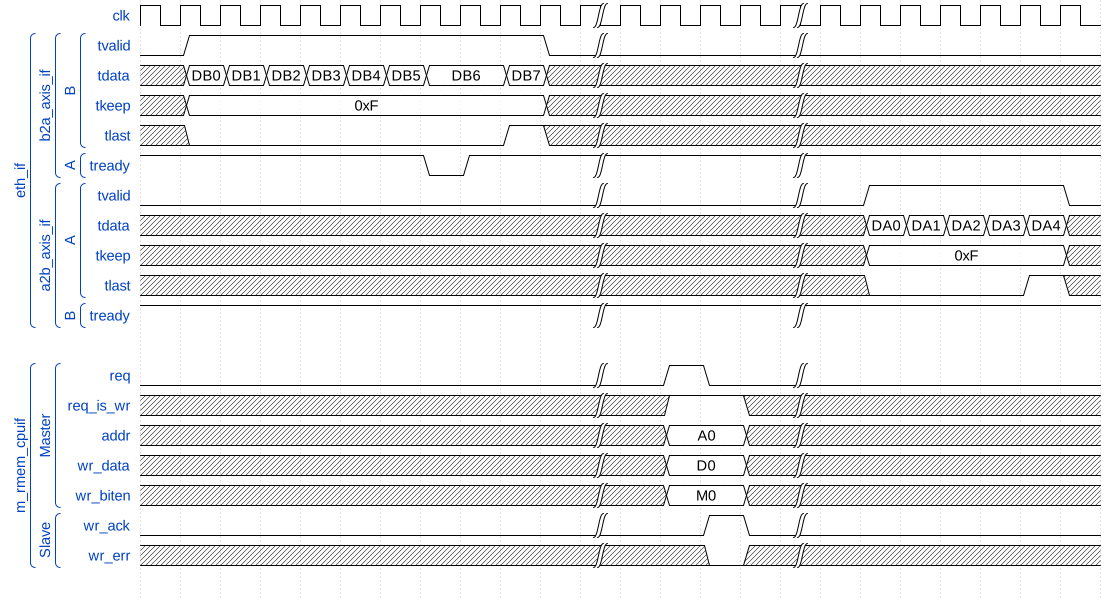
Received RMEM write completes locally before the Ethernet response
Multicast, failures, and timeout recovery
An accepted multicast write is serviced locally, with response suppression handled by oETP. Servicing failures still update the receiving peer’s error state and retain an enabled notification. A malformed final trailer may be detected after memory writes have occurred; those writes are retained. Local AXI causes 4..7 take precedence over a consequent framing error.
The CSR trace below follows peers.entry[I0].dma. A unicast block
times out with TIMEOUT, returns to idle, and leaves done clear.
The error remains recorded until software requests clear_error.
That command clears the peer error record independently of IRQ completion.
A later request then succeeds and sets done. Starting or successfully
completing another block does not itself clear an older error.
Timeout cancels unsent fragments. A late reply cannot revive the aborted block; a new operation uses a new wire Request ID. For an initiating RMEM timeout, the window still acknowledges the access and returns all-ones read data for a read, while recording the failure and retaining a separate RMEM notification.
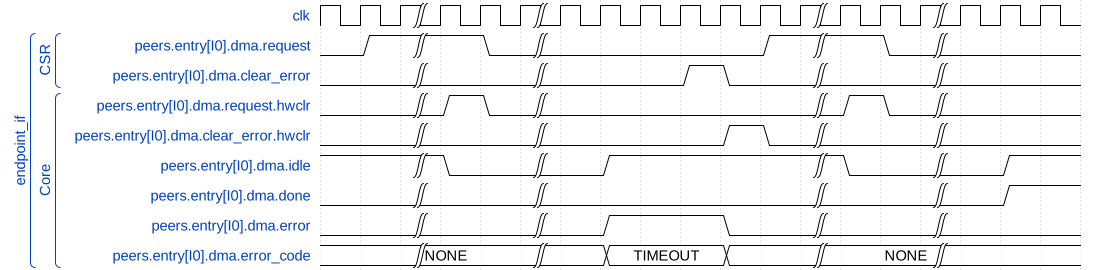
Peer timeout recorded until explicit clear and a later successful restart
Backpressure and full IRQ queues
The FIFO adapters preserve byte order and valid-byte counts across the
32-bit CSR, DMA, and Ethernet streams. A 64-byte raw frame has 16 full beats,
while a 65-byte raw frame has 16 full beats followed by a final beat with
tkeep = 0x1 and tlast = 1. Only the final beat may have a partial KEEP mask.
FIFO backpressure preserves each pending beat and its metadata.
The IRQ example starts with IRQ_FIFO_DEPTH = 2 and two queued
direct RX notifications, source EVENT_NON_OETP_DIRECT_RX_AVAILABLE, peer index zero,
with distinct sequences Q0 and Q1. The physical IRQ is initially
masked. A third direct frame is already pending, but its first CSR word
cannot become visible until event capacity is reserved.
Software unmasks IRQ in cycle 1; irq asserts in cycle 2 without
changing the queued claims. Completing Q0 in cycle 3 allows
the controller to reserve that same capacity for the pending notification.
The first CSR word becomes visible in cycle 5, and the new claim
Q2 is queued in cycle 7. Credit remains full while its occupancy
moves from a queued claim to a reservation and back to a queued claim.
Software completes Q1 in cycle 9 and Q2 in cycle 12.
The queue then empties and IRQ deasserts in cycle 13. Overflow stays clear.
Completing these notifications does not consume the received frame; the
first visible CSR word remains pending until software reads it.
Initiating RMEM failures and received-request errors retain their local completion independently of a full notification queue. The initiating RMEM source-enable decision is captured when the failure is recorded, so a delayed IRQ admission cannot reinterpret that decision.
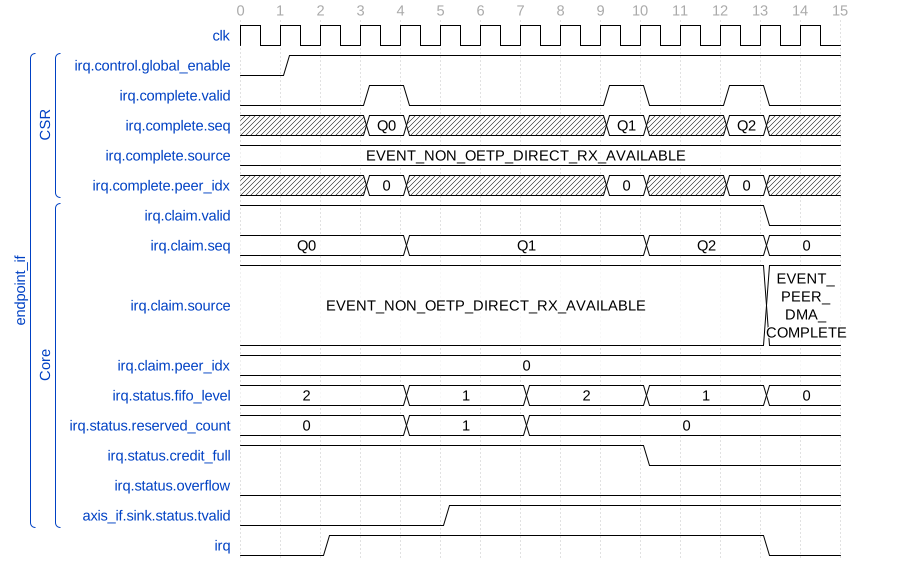
Queued IRQ claims and a reserved direct RX notification under full capacity
Verification
The test suite is in dv/core/openenoc_endpoint_interface/.
Testbench
This cocotb suite verifies the integrated endpoint interface without a CPU or generated CSR register block. It exercises the actual DMA and oETP engines, peer lookup, IRQ controller, and stream FIFOs together. External fixtures provide a cocotb AXI RAM model, Ethernet stream models, an acknowledged local CPUIF service, and memory-error injection. All cases use fixed 32-bit AXI and Ethernet data paths. The fixture has two peers, 128-byte transport FIFOs, two IRQ credits, four fragment slots, and a 64-byte raw-frame ceiling.
Twelve cases exercise direct/raw streams, both bulk DMA modes, sequential multi-fragment transfers, incoming request servicing, multicast, RMEM initiation and execution, local/remote errors, timeout abort, and retained IRQ notifications with a full queue.
Coverage
The suite covers:
direct RX availability before frame completion and direct TX completion after the transport FIFO;
Ethernet/CSR backpressure and complete IRQ admission/commit accounting;
direct TX readiness following downstream capacity through CSR acknowledgements and frame boundaries, IRQ-qualified readiness, and enabled/disabled TX-event admission with a full queue;
IRQ-qualified TX readiness closed by TLAST and reopened only by a new admission, independently of IRQ queue completion or newly available credit;
raw DMA TX/RX, descriptor claims, and receive MAC filtering;
sequential fragmented reads/writes, little-endian metadata, rounded MFS, and partial tails;
fragment timeout, unsent-fragment cancellation, late responses, software restart, and remote errors;
incoming memory requests, range checks, multicast writes, response suppression, and local events;
bad EndOfData after memory TLAST, terminal-status joins, partial writes, and absence of rollback;
initiating RMEM translation, BitEnable, failed-read ACK/data, timeout, and independent error notification;
received RMEM access, delayed ACK, local errors, and zero-BitEnable writes;
RMEM priority between bulk fragments and original AXI-cause preservation;
full IRQ queue, independent CPUIF/ERROR_RSP completion, per-peer notification retention/coalescing, and enable changes;
a new one-cycle CPUIF request on the preceding ACK cycle and recovery after failures.