IRQ controller – openenoc_endpoint_irq_controller
Collects admitted hardware events into ordered interrupt claims for software completion.
Source: openenoc_endpoint_irq_controller.sv.
Parameters
Name |
Default value |
Allowed values |
Description |
|---|---|---|---|
|
|
Integer >= 1 |
Number of independent interrupt-event producer ports. |
|
|
Integer >= 1 |
Shared capacity for queued claims and producer reservations. |
|
|
1..11 |
Event peer-index width, bounded by the generated CSR claim field. |
|
|
1..16 |
Interrupt claim sequence width, bounded by the generated CSR token field. |
|
|
EVENT_PORTS-bit mask |
A set bit means the producer has already sampled the source-enable decision. |
Signals
Interface ports contain channels in both directions. The table identifies the selected modport or stream role; member directions follow that interface.
Name |
Type |
Direction / role |
Description |
|---|---|---|---|
|
|
input |
Clock for this component or interface domain. |
|
|
input |
Active-high reset of transaction and control state. |
|
|
bidirectional (core) |
IRQ enables, claim and completion fields, status, and error-clear commands. |
|
|
output |
Level interrupt notification to software. |
|
openenoc_irq_event_if.controller |
bidirectional (controller) |
Producer admission and commit channels. |
Architecture and operation
Boundary and parameters: event_if[EVENT_PORTS] accepts producers of
IRQ event producer – openenoc_irq_event_if; endpoint_if exposes enable, claim, completion,
and error controls; irq notifies software. Defaults are
EVENT_PORTS = 6, FIFO_DEPTH = 16, PEER_IDX_W = 1,
SEQUENCE_W = 16, and SAMPLED_ENABLE_MASK = 0.
Peer and sequence widths must fit their generated CSR fields.
Endpoint integration uses seven producer ports and marks port 5 (initiating
RMEM error) as having already sampled its source enable. For that port,
admit_enable includes the captured enable decision, and the controller
does not re-read the live source CSR. For unmarked ports, the controller
combines admit_enable with the source-enable CSR when preparing the
registered admission offer. Later enable changes do not revise that offer
or cancel accepted reservations.
Admission and commit use independent round-robin SELECT/OFFER machines. Selection prepares a registered READY offer; the next edge accepts the producer’s stable VALID and metadata. Each channel accepts at most one enabled operation every two cycles. Disabled admissions can be offered to multiple ports in parallel. Admission reserves credit for a particular producer port; another port cannot consume that reservation, even if both ports report the same event source.
The FIFO capacity is shared by queued claims and reservations. An enabled admission reserves capacity when its READY offer is prepared, before the handshake completes. Withdrawing VALID during that offer releases the provisional reservation. A commit converts one of its port’s reservations into a queued claim without changing the total occupied capacity. A full credit pool blocks new enabled admissions but permits commits backed by existing reservations. A matching completion releases a queued credit, which can fund a new registered admission offer on the same edge.
Claims are ordered by accepted commits, which may differ from admission
order. Each accepted commit receives the next sequence number, starting at
zero after reset and wrapping modulo 2**SEQUENCE_W. These sequence
tokens are independent of oETP Request IDs. The current head remains stable
until software completes it. A matching completion and an already offered
commit can replace the head on the same edge without dropping claim validity.
Software completes a claim by copying its valid, sequence, source, and peer
fields to irq.complete. All token fields must match the head, including
zero extension into unused upper CSR bits when parameter widths are smaller.
The controller acknowledges a completion command through
complete.valid.hwclr whether the token matches or not. A mismatch, or a
command with no claim pending, leaves the queue unchanged and sets sticky
status.invalid_complete. A commit without a reservation on its producer
port, or without queue space, sets status.overflow and creates no claim.
control.clear_errors clears these two controller diagnostics; a new
error on the same edge takes precedence. Completion and clear commands are
each applied once while their command bit remains asserted. Their registered
hwclr outputs stay high until the respective input bit is sampled low.
Clearing controller or DMA errors is separate from completing a claim.
The global enable masks only the physical level IRQ. Event capture, credit
accounting, and claim visibility continue while it is low. The registered
irq and status.irq_asserted reflect the sampled global enable and
whether claims remain after the edge’s queue updates.
status.claim_pending follows claim validity independently of this mask.
status.fifo_level counts queued claims; status.reserved_count
counts reservations, including provisional READY offers. Both CSR counters
saturate at 255. status.credit_full uses the exact internal counts,
so saturation does not affect capacity control. Reset clears claims,
reservations, sequence state, handshakes, IRQ, and controller diagnostics.
Functional scenarios
The admission/commit contract is illustrated in IRQ event producer – openenoc_irq_event_if,
and firmware IRQ service is illustrated in Full endpoint – openenoc_endpoint_full.
The examples here focus on controller credit accounting and claim retirement.
They use EVENT_PORTS = 1, PEER_IDX_W = 2, and
SEQUENCE_W = 16; each states its FIFO depth.
S0 denotes EVENT_PEER_DMA_COMPLETE (source 0), enabled throughout.
The producer uses admit_enable = 1 and admit_source = S0;
all commits use commit_source = S0. I0 and I1 denote
distinct peer indices. D0 and D1 are complete claim words with
sequence numbers 0 and 1, respectively, source S0, and peer indices
I0 and I1.
Numbered cycles label intervals between rising edges. Admission and commit
transfer at an interval’s ending rising edge when VALID and READY are high.
CSR command bits are sampled at the same edge. CSR field paths are
relative to endpoint_if.csr_to_core for CSR inputs and
endpoint_if.core_to_csr for Core outputs;
generated .value and .next wrappers are omitted. The diagrams
show the controller boundary, so they do not include CSR bus transaction
latency. claim and complete denote packed words while valid;
x marks irrelevant values.
IRQ masking, shared credit, and completion-edge reuse
Use FIFO_DEPTH = 1, initially empty after reset. The physical IRQ is
masked by control.global_enable = 0. Preparing the first admission
offer reserves the only credit: status.reserved_count = 1 and
status.credit_full = 1 are already visible in cycle 2, when the
admission handshake occurs.
The first commit transfers in cycle 4. In cycle 5, the reservation has
become queued claim D0: status.reserved_count falls to zero,
status.fifo_level rises to one, and status.credit_full remains
asserted. The claim is visible even though irq = 0. A second enabled
admission waits from cycle 5 because no credit is free.
Software raises the global enable in cycle 7, so irq rises in
cycle 8. The matching completion D0 is sampled at the end of
cycle 8. That edge removes the claim and prepares the waiting admission
offer. In cycle 9, the FIFO is empty, a new reservation occupies its
capacity, and status.credit_full is still asserted. The second
admission transfers in that cycle.
Its commit transfers in cycle 11 and becomes claim D1 in cycle 12.
Because the global enable remains high, this new claim also raises
irq. Masking the IRQ never released either operation’s credit.
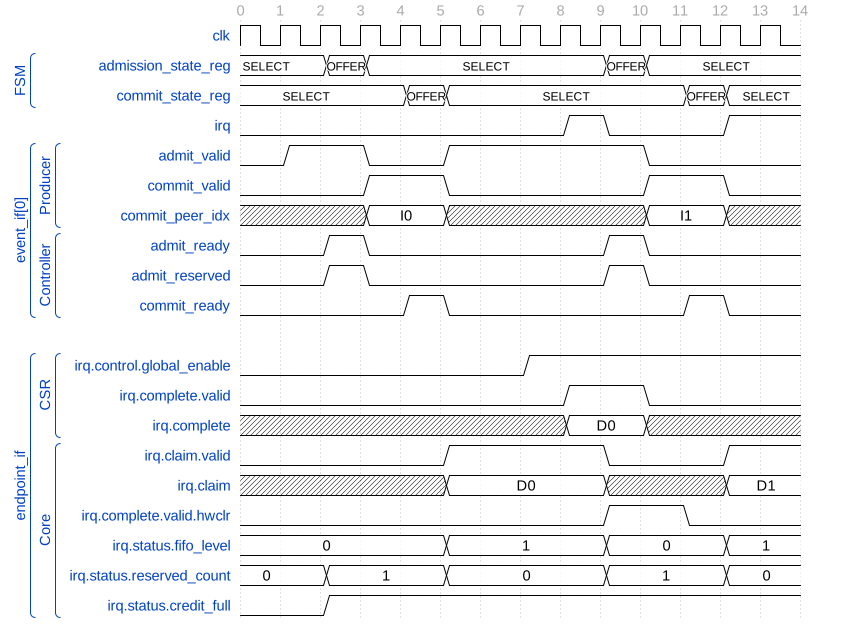
IRQ masking and reuse of shared FIFO credit
Exact completion tokens and simultaneous head replacement
Use FIFO_DEPTH = 2 and control.global_enable = 1. Initially,
claim D0 occupies one entry, and the same producer already holds
a reservation for its second operation. No new admission is needed in the
shown interval. D2 copies D0 except for an incorrect sequence
number.
Software asserts complete.valid with D2 in cycle 1 and holds
it through cycle 3. The controller acknowledges the command in cycle 2
and sets status.invalid_complete, while D0, FIFO occupancy,
and irq remain unchanged. The acknowledgement therefore confirms
command processing, not successful claim retirement.
In cycle 5, software presents the correct D0 token and requests
error clearing. On the same edge, the producer commits its second
operation with peer I1. Claim D1 replaces D0 in
cycle 6: claim.valid and irq remain high, FIFO occupancy stays
at one, and the remaining reservation is consumed.
The old completion D0 stays asserted through cycle 7, but it is
applied only once. It does not remove D1 or reassert
status.invalid_complete after the clear. Software releases the
command, then submits D1 in cycle 9. The queue becomes empty and
irq falls in cycle 10.
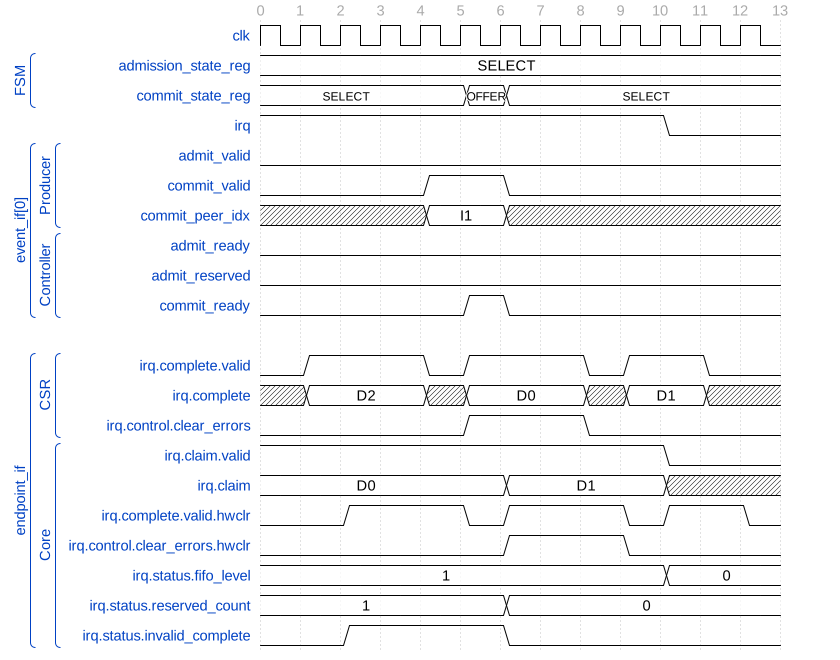
Exact completion matching and claim replacement without an IRQ gap
Verification
The test suite is in dv/core/openenoc_endpoint_irq_controller/.
Testbench
This cocotb suite verifies the IRQ controller in isolation from the processor, CSR register block, and event producers. The wrapper flattens CSR fields and event interfaces for cocotb. Eight cases run in eight configurations covering 1–7 producer ports, FIFO depths 1, 3, 4, 7, 8, 16, and 260, peer widths up to 11 bits, and sequence widths up to 16 bits.
The tests check independent producer arbitration and credits, FIFO pressure, exact completion tokens, simultaneous completion and commit, held CSR commands, IRQ masking, sequence wrap, status saturation, and output stability between clock edges.
Coverage
The suite covers:
reset of claims, reservations, sequence state, and sticky diagnostics;
locally disabled admissions and all six source enables, including RMEM_ERROR;
per-producer reservations, including independent initiator/responder ports sharing source 0;
independent round-robin admission and commit arbitration;
FIFO-full backpressure, capacity reuse, and simultaneous claim enqueue/dequeue;
ordered, stable claims with preserved peer indices and exact completion-token matching;
invalid tokens, nonzero unused token bits, and commits without reservations;
global IRQ masking, sequence wraparound, arbitrary FIFO depths, and 8-bit status saturation;
registered output stability and one application of held CSR completion/clear commands.