Direct AXIS over CSR – openenoc_endpoint_direct_axis
Connects software-controlled direct frame streams to endpoint transport and interrupt reporting.
Source:
RTL source.
Parameters
Name |
Default value |
Allowed values |
Description |
|---|---|---|---|
|
Required |
|
Direct-stream route encoding supplied from the DMA transfer interface. |
Signals
Interface ports contain channels in both directions. The table identifies the selected modport or stream role; member directions follow that interface.
Name |
Type |
Direction / role |
Description |
|---|---|---|---|
|
|
input |
Clock for this component or interface domain. |
|
|
input |
Active-high reset of transaction and control state. |
|
|
input |
Final direct-frame beat accepted at the oETP input after FIFO/mux transport. |
|
|
bidirectional (core) |
Direct TX data/control, RX data/status, and hardware command clears. |
|
|
source |
Software-controlled transmit frame stream. |
|
|
sink |
Receive frame stream consumed through CSR reads. |
|
|
bidirectional (producer) |
Direct transmit completion-event producer. |
|
|
bidirectional (producer) |
Direct receive-availability event producer. |
Architecture and operation
This block bridges the direct CSR stream registers in endpoint_if to
m_axis_csr_tx and s_axis_csr_rx. The CSR path carries 32-bit data
and four-bit KEEP masks. Endpoint interface – openenoc_endpoint_interface connects both streams
at that width and provides FIFO/mux transport toward the Ethernet link.
The block preserves payload bytes, KEEP, and LAST; software supplies the
Ethernet header as part of the frame. ROUTE_DIRECT identifies the
internal direct-stream route.
Separate TX and RX clocked processes own stream state and CSR acknowledgements. Each AXIS boundary uses a two-entry AXI-Stream register slice (skid buffer), including a registered READY path. CSR data/status and hardware-clear outputs are registered. An empty slice can accept words while its output is stalled; backpressure reaches the preceding stage when its two storage slots are occupied.
For TX, software writes axis_if.source.data.tdata, sets KEEP/LAST in
source.control, and finally sets source.control.tvalid. It retains
the word until hardware clears that command. source.status.tready is
registered readiness status; the command-clear handshake confirms that
the word was accepted into the local TX slice. Software may submit the
next word after control.tvalid reads zero. In particular, the stream
HAL’s return after submitting the final word does not imply TX completion.
Without a direct TX event, source.status.tready is a registered copy
of READY at the TX slice input. It follows downstream backpressure through
the slice’s registered READY path. An empty slice can remain ready while
its output is stalled, until both storage slots are occupied. CSR command
acknowledgements and frame boundaries do not themselves lower this status.
With a direct TX event enabled, readiness additionally requires frame
admission. Software presents the first word and sets control.tvalid
to request admission. Its handshake opens the frame and enables readiness
when the slice has capacity. Acceptance of tlast closes the frame and
deasserts readiness on that same edge. Readiness then stays low until the
next frame receives its own admission. The IRQ controller checks and reserves
event space during admission; TX readiness does not inspect queue occupancy.
Completing or removing a queued IRQ event does not itself reopen the frame.
The active frame retains the controller’s reserved/unreserved decision even
if software changes the event-enable bit.
The readiness status and CSR command acknowledgement have separate roles.
Software retains data, KEEP, and LAST until control.tvalid clears,
including when the readiness status remains high during that acknowledgement.
For RX, software waits for axis_if.sink.control.tready = 0 and
sink.status.tvalid = 1, reads data/KEEP/LAST, and then sets
sink.control.tready. Hardware consumes the pending word and clears
that command. The word stays stable while visible and unacknowledged.
Pending-beat flags suppress duplicate acceptance while a CSR VALID or
READY remains set during its registered acknowledgement.
Each frame requests admission on its own IRQ event producer – openenoc_irq_event_if producer.
TX uses source 3 (NON_OETP_DIRECT_TX_COMPLETE); RX uses source 4
(NON_OETP_DIRECT_RX_AVAILABLE). Both drive admit_enable = 1
and commit with peer index zero. An enabled source needs a reservation
before the frame can proceed. A disabled source can be admitted with
admit_reserved = 0 and produces no later commit. Masking the physical
IRQ alone does not disable event collection or remove this credit limit.
One direct TX frame is active at a time. A reserved event retains its
credit through the FIFO/mux transport until tx_frame_done reports
acceptance of the final direct beat at the oETP input. Its subsequent commit
must finish before another TX frame is admitted. Without a reservation,
tx_frame_done alone releases the active-frame context. This completion
identifies the local frame boundary; reception at a remote endpoint is not
acknowledged.
RX commits its availability event when the first word becomes visible,
so notification can precede the rest of the frame. The remaining words
use that frame’s admission, without reserving another event per word.
When admission is blocked, the input slice may still prefetch up to two
words, but the first word is not exposed in the CSR status until admission
can proceed. rst clears slice contents, pending-beat flags, active-frame
state, and local event context.
Functional scenarios
The examples use the firmware’s 66-byte raw Ethernet frame on the 32-bit
direct path. Frame length excludes preamble, SFD, and FCS. A frame has
16 full words with tkeep = 0xF and a final word with tkeep = 0x3
and tlast = 1. DA0 through DA16 denote transmitted words;
DB0 through DB16 denote received words.
CSR field paths are relative to endpoint_if. Generated
.value/.next wrappers are omitted, and .hwclr denotes a
registered hardware acknowledgement. clk is the common module clock.
Numbered intervals end at the rising edge that samples their values.
Gaps marked | omit software execution, intermediate word handshakes,
and FIFO/mux waiting time; they do not specify fixed firmware or transport
latency. Shaded x values are irrelevant outside their valid interval.
Transmit a 66-byte frame without an IRQ event
Software disables the direct TX event source by clearing
irq.event_enable.non_oetp_direct_tx_complete before starting the
frame. This selects operation without a TX notification; the physical
IRQ mask is independent of event generation. The producer still requests
admission for source 3 with admit_enable = 1, but the controller
accepts it with admit_reserved = 0. This admission consumes no IRQ
credit and can proceed even when the IRQ queue is full.
Software can wait for the initially asserted source.status.tready.
It writes data, KEEP, and LAST before setting
source.control.tvalid. It polls that command until hardware clears
it, then submits the next word. The example transmits DA0 through
DA16: 16 full words followed by a two-byte final word. The first
gap omits the CSR and AXIS handshakes for DA1 through DA15.
No interrupt handler or claim completion is needed to advance the stream.
After DA16 is acknowledged, software can queue DA17, the first
word of the next frame. That CSR command remains pending while the
previous frame drains through the downstream transport. Its data, full
KEEP, and LAST clear remain unchanged during the wait.
tx_frame_done releases the previous frame’s context directly,
because no event was reserved. The next frame then receives its own
unreserved admission, and hardware accepts and acknowledges DA17.
commit_valid remains low throughout. The rest of that next frame
continues beyond the shown interval.
The CSR acknowledgement confirms word acceptance into the local slice.
Polling the final command’s clear therefore confirms submission, while
the later tx_frame_done establishes the local downstream frame
boundary. Hardware sequences queued frames across that boundary without
requiring a software TX-completion interrupt.
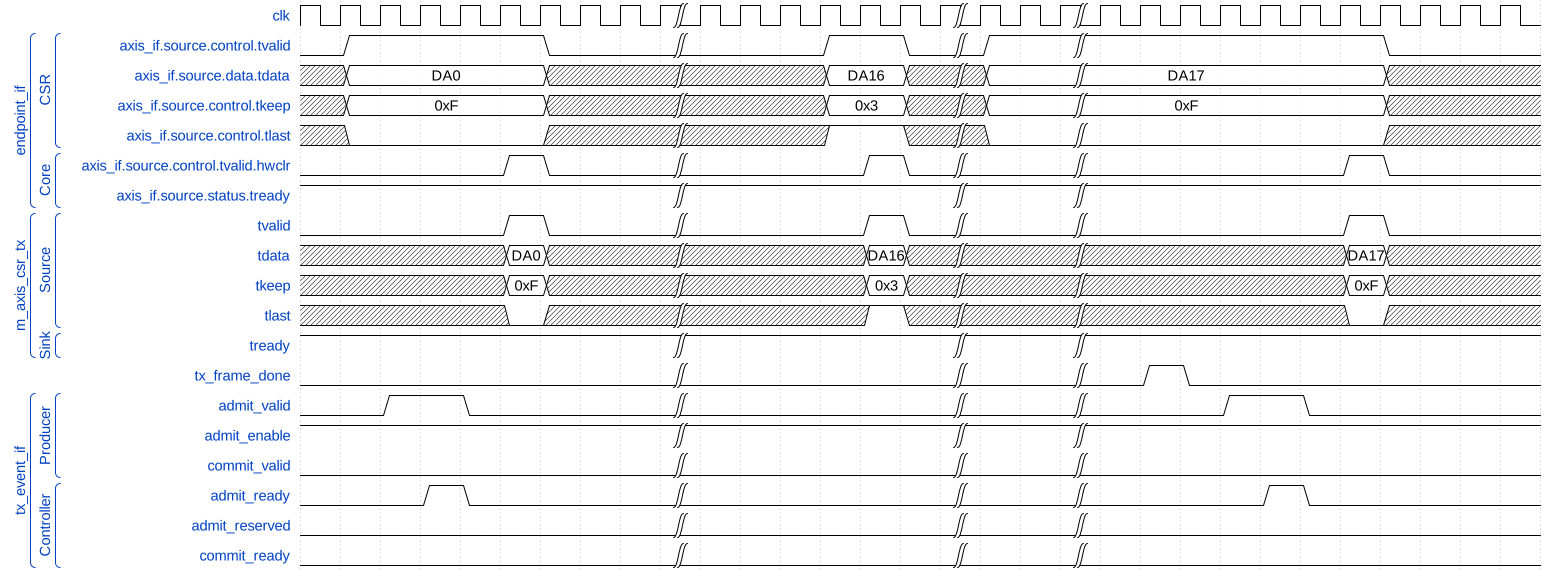
Polling transmission of a 66-byte frame without an IRQ event
Single-frame transmit and completion after the downstream frame boundary
Software presents DA0 with full KEEP and LAST clear, starting admission
for source 3. The controller grants a reservation before the word enters
the TX slice. source.status.tready then reflects the admitted frame’s
downstream capacity. source.control.tvalid.hwclr acknowledges the
accepted word one clock later.
The registered AXIS output then presents that same word to the transport.
The acknowledgement can precede acceptance at m_axis_csr_tx if the
slice’s output is stalled, as shown in the held-command scenario.
After the omitted handshakes for DA1 through DA15, software submits
DA16 with tkeep = 0x3 and LAST set. Hardware acknowledges that
word and stops accepting another frame while the current one drains.
Acceptance of DA16 at m_axis_csr_tx transfers it to the next
transport stage; the reserved event is still pending.
Only the later tx_frame_done pulse permits the TX event to commit.
The producer holds commit_valid while commit_ready is low,
retaining its reservation. The successful commit releases the frame
context. Both admission and commit identify source 3; the commit uses
peer index zero.
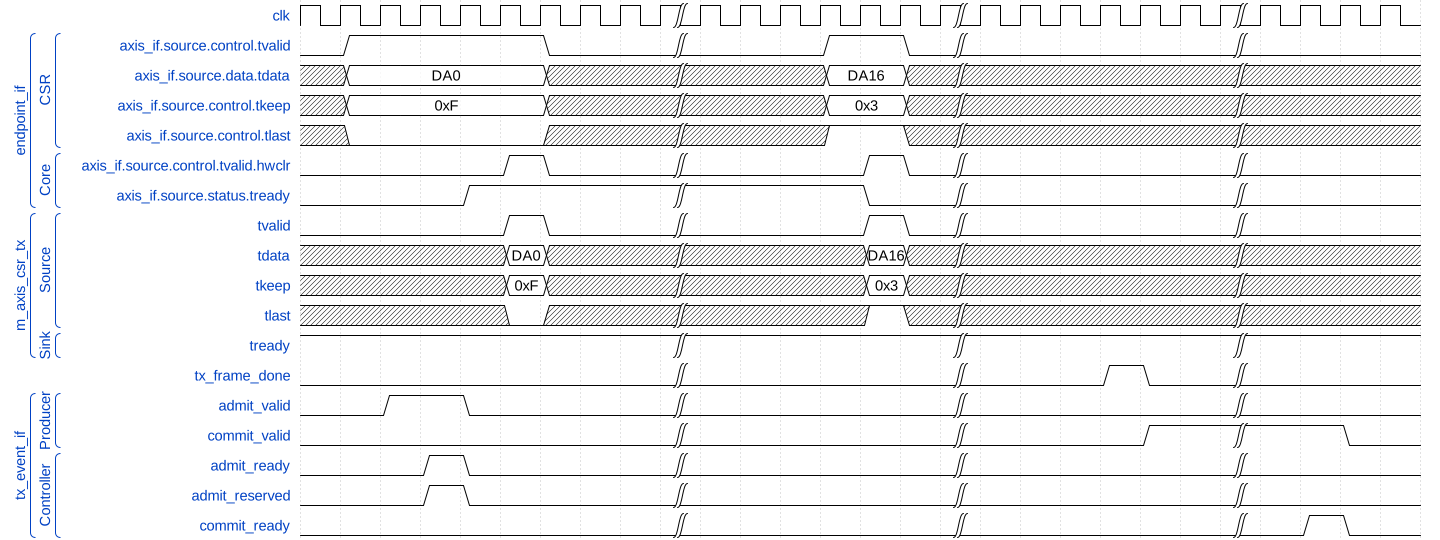
CSR transmit acknowledgements precede the final downstream TX event
Receive a buffered 66-byte frame through CSR
The FIFO connected to s_axis_csr_rx already contains the complete
66-byte Ethernet frame before the example starts. It asserts tvalid
and presents each word until tready accepts it. Availability of later
words never stalls the source; all pauses result from the receiving block
and software’s CSR acknowledgements.
The empty two-entry input slice first accepts DB0 and DB1 in
successive transfers. It then deasserts input tready while the FIFO
holds DB2, full KEEP, and LAST clear. RX admission succeeds for source
4 with a reservation. DB0 becomes visible through sink.data/status,
and its availability event commits before software acknowledges the word.
Only one availability event is generated for the frame.
Software reads data, KEEP, and LAST before setting sink.control.tready.
Hardware consumes one word and acknowledges it with the registered
control.tready.hwclr. The pending-beat protection prevents a held CSR
ready command from consuming another word. Freeing a slice entry permits
the FIFO to transfer its next word, so input READY rises in response to
CSR consumption rather than remaining high throughout the frame.
The middle gap omits FIFO transfers for DB3 through DB15 and
CSR acknowledgements for DB1 through DB13. After the gap, software
is reading DB14 while the FIFO holds the final word DB16.
Acknowledging DB14 allows DB16 into the input slice. The FIFO
then deasserts s_axis_csr_rx.tvalid because all 17 words have been
transferred, while DB15 and DB16 still await CSR consumption.
The first 16 words have tkeep = 0xF and LAST clear. The final word
has tkeep = 0x3 and LAST set. Software acknowledges that last word
after reading its two valid bytes, completing a total of 66 bytes.
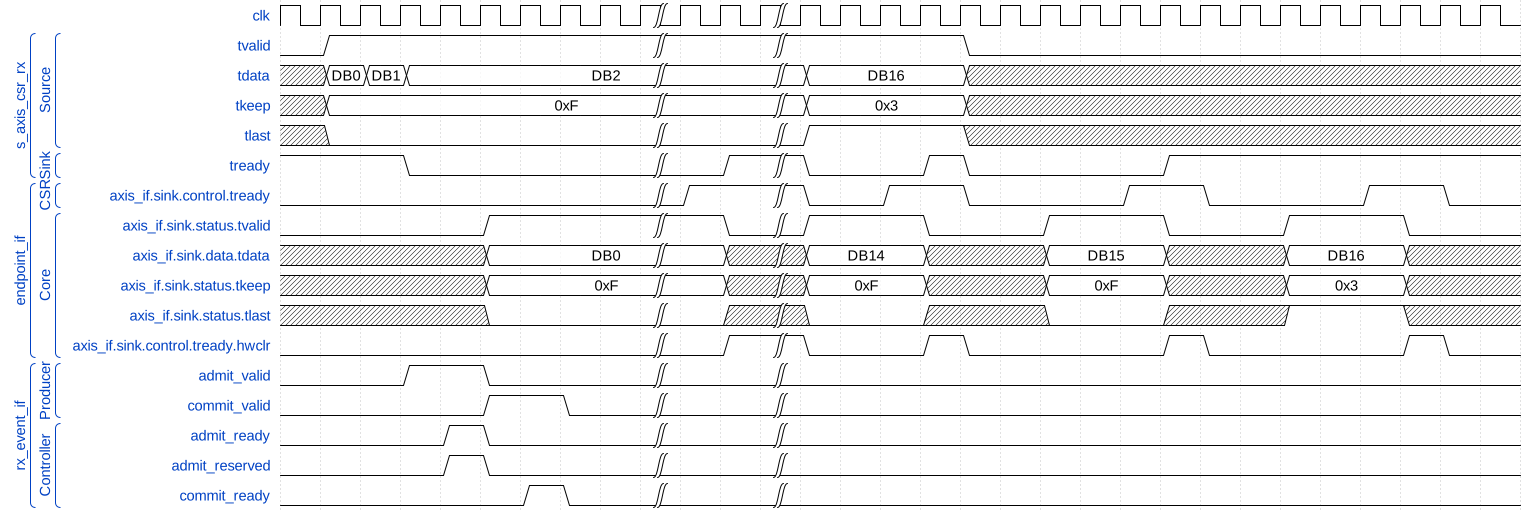
CSR reception of a 66-byte frame already buffered in the input FIFO
Held CSR commands, stream stalls, and IRQ admission
This example shows the beginning of another 66-byte TX frame;
DA1 through DA16 continue beyond the displayed interval.
The TX register slice is initially empty and the enabled IRQ source
has no available credit. Software holds the first word DA0 and
control.tvalid while admission waits through cycle 4. No word
is accepted before admission transfers in cycle 5 with a reservation.
source.status.tready remains low while that first command waits for
admission.
The empty slice accepts DA0 in cycle 6 even though the external
m_axis_csr_tx.tready remains low. In cycle 7, hardware asserts
control.tvalid.hwclr and the output presents DA0. The CSR command
is still high in that cycle, but the pending-beat flag prevents another
acceptance. The generated CSR clears the command in cycle 8.
source.status.tready is already active in cycle 6: admission has
succeeded and the slice still has room for another word. Software retains
the current CSR command until its clear, independently of this status.
The output holds DA0, full KEEP, and LAST clear until the transfer
in cycle 12. Exactly one copy reaches the downstream sink. Registered
source.status.tready can become active before that transfer because the
slice has room for another word. It does not imply that the pending
output beat or the frame has finished. commit_valid stays low
because this frame’s final downstream boundary has not occurred.
On RX, the corresponding held READY protection is shown in the preceding
scenario. When RX admission is blocked instead, prefetched words remain
in the input slice, sink.status.tvalid stays low, and upstream
backpressure follows once the slice fills. Freeing IRQ credit permits
the same pending frame to become visible without losing its first word.
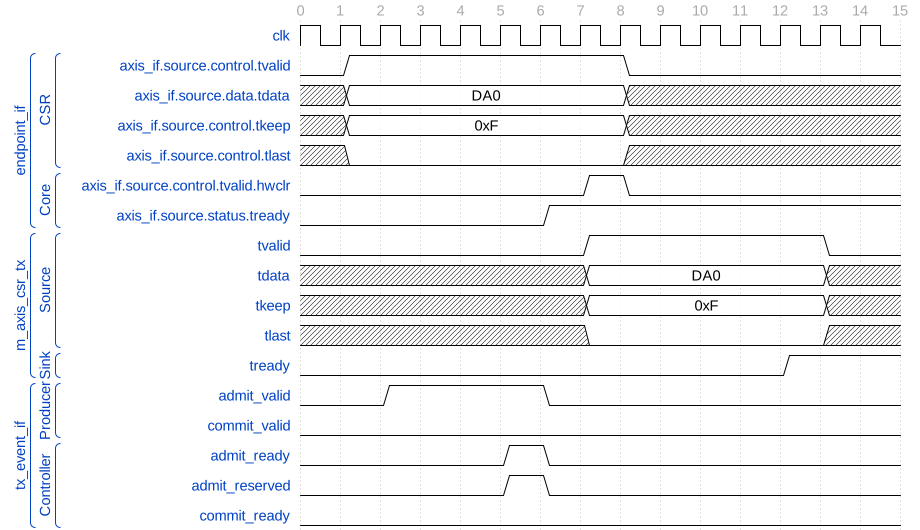
A held TX command survives IRQ admission delay and downstream backpressure