IRQ event producer – openenoc_irq_event_if
Defines interrupt-event admission and later commitment by a hardware producer.
Source: openenoc_irq_event_if.sv.
Parameters
Name |
Default value |
Allowed values |
Description |
|---|---|---|---|
|
|
Integer >= 1; enough bits for the peer count |
Width of local peer indices; all connected interfaces must agree. |
The current IRQ controller – openenoc_endpoint_irq_controller implementation accepts
PEER_IDX_W from 1 to 11 so indices fit the generated CSR claim field.
Signals
Directions are relative to the producer and controller modports.
The mon modport observes all signals as inputs.
Name |
Type |
Direction / role |
Description |
|---|---|---|---|
|
|
producer: output; controller: input |
Producer requests admission before the event operation starts. |
|
|
producer: input; controller: output |
Accepts the admission when admit_valid is also asserted. |
|
|
producer: output; controller: input |
Event class code to evaluate against source enables. |
|
|
producer: output; controller: input |
Producer enable decision, including any previously sampled source enable. |
|
|
producer: input; controller: output |
Reservation result sampled with admit_valid and admit_ready; one reserves a FIFO credit. |
|
|
producer: output; controller: input |
Producer offers a completed admitted event. |
|
|
producer: input; controller: output |
Accepts the completed event when commit_valid is also asserted. |
|
|
producer: output; controller: input |
Committed event class code. |
|
|
producer: output; controller: input |
Peer index for peer-DMA and RMEM-error events; ignored for other sources. |
Architecture and operation
Parameter and roles: PEER_IDX_W defaults to 1. Modports are
producer, controller, and mon. Clock and reset belong to the
connected modules.
Admission and commit use independent ready/valid handshakes. Admission
transfers on a rising edge with admit_valid && admit_ready; commit
transfers on a rising edge with commit_valid && commit_ready. The
producer asserts each VALID when the corresponding transfer is available,
without waiting for READY, and retains it until acceptance. It keeps
admit_source and admit_enable stable while admission is pending,
and commit_source and commit_peer_idx stable while commit is pending.
The admission channel is used before an operation starts, or when a received
request/RMEM failure is recorded. The controller evaluates admit_source
against the configured source enable and the producer’s admit_enable.
For producers that have already sampled the source enable, that captured
decision is included in admit_enable. The controller samples the enable
decision and reserves capacity when it prepares its registered admission
offer. Later enable changes do not revise that offer.
The producer samples admit_reserved with the admission handshake and
retains the result with its operation context. A value of 1 reserves FIFO
capacity for exactly one later commit on the same producer port. A value of
0 accepts the admission without an IRQ reservation, so that operation must
not submit a commit. The operation itself may still proceed. The reservation
result is meaningful with the admission handshake; it need not remain
asserted while the operation runs.
When a reserved operation completes, the producer submits its event class
and peer index. The accepted commit converts the saved reservation into a
queued event. Changes to event enables after admission do not cancel that
commit. The current controller retains commit_peer_idx for
EVENT_PEER_DMA_COMPLETE and EVENT_RMEM_ERROR; it records zero for
the remaining source classes.
These are local IRQ FIFO reservations, independent of the oETP wire protocol. The interface contains no clock/reset ports or internal storage.
Code |
Interface constant |
Meaning |
|---|---|---|
0 |
|
Peer bulk-DMA completion or servicing failure. |
1 |
|
Raw DMA transmit completion. |
2 |
|
Raw DMA receive completion. |
3 |
|
Direct CSR frame transmit completion. |
4 |
|
Direct CSR frame available for reception. |
5 |
|
Scalar RMEM failure. |
The controller behavior is described in IRQ controller – openenoc_endpoint_irq_controller.
Functional scenarios
The examples use PEER_IDX_W = 2 and event source
EVENT_PEER_DMA_COMPLETE; I0 and I1 denote
peer indices. Labels are local to each diagram.
clk is the common clock of the connected logic, shown as a sampling
reference. Numbered cycles label intervals between rising edges; transfers
occur at each interval’s ending rising edge when VALID and READY are both
high. Shaded x regions mark irrelevant values, not a requirement to
drive unknowns. Waiting times depend on the connected logic and are not
interface latency guarantees.
Enabled admission and reserved capacity
The producer presents admit_source = EVENT_PEER_DMA_COMPLETE and admit_enable = 1
with admit_valid = 1 in cycle 1. The source is enabled in the
controller configuration, and capacity is available. In cycle 2, the
controller asserts admit_ready with admit_reserved = 1.
The producer samples the reservation at the ending rising edge and
deasserts admit_valid in cycle 3.
The producer retains the reservation while the operation runs. In cycle 5,
it presents the completed event with commit_source = EVENT_PEER_DMA_COMPLETE,
commit_peer_idx = I0, and commit_valid = 1. These fields
remain stable until the commit transfers in cycle 6 with
commit_ready = 1. The producer deasserts commit_valid in
cycle 7. This consumes the earlier reservation exactly once.
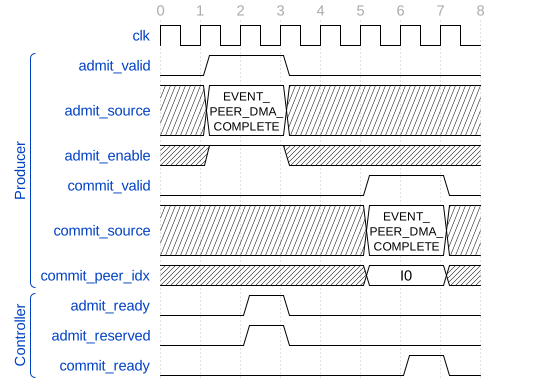
Enabled event admission followed by a reserved commit
Disabled admission without a later commit
Two admissions illustrate disabled event production. For the first, the
source is enabled in the controller, but the producer supplies
admit_enable = 0 with EVENT_PEER_DMA_COMPLETE in cycle 1. The admission
transfers in cycle 2 with admit_reserved = 0.
Before the second admission, the controller’s source-enable setting for
EVENT_PEER_DMA_COMPLETE is cleared. The producer supplies admit_enable = 1 in
cycle 5, but the admission still transfers without a reservation in cycle 6.
Both operations may proceed after admission. Neither has reserved an IRQ
event, so neither sends a later commit. commit_valid remains low
when the operations finish, even if the source is subsequently enabled.
Disabled admissions do not require free IRQ FIFO capacity.
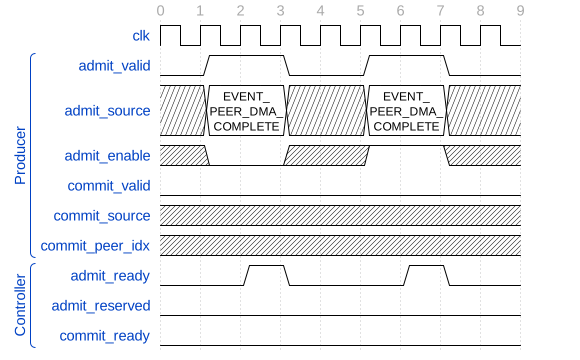
Disabled admissions accepted without a commit reservation
Delayed commitment, backpressure, and peer metadata
The producer requests admission for EVENT_PEER_DMA_COMPLETE in cycle 1, while capacity
is unavailable. It keeps admit_valid, admit_source, and
admit_enable unchanged through cycle 4. The controller then offers
capacity with admit_ready = 1 and admit_reserved = 1;
the admission transfers at that cycle’s ending rising edge.
The reservation remains associated with the operation after
admit_reserved returns low in cycle 5. A source-enable change in
cycle 6 does not alter the accepted reservation. The operation completes
later, and the producer asserts commit_valid in cycle 8 with
commit_source = EVENT_PEER_DMA_COMPLETE and commit_peer_idx = I1.
With commit_ready = 0 in cycles 8 and 9, the producer retains
VALID and both metadata fields. The commit transfers in cycle 10 when
commit_ready = 1, and the producer deasserts VALID in cycle 11.
The committed peer index identifies the completed operation, even though
no peer index was transferred on the earlier admission channel.
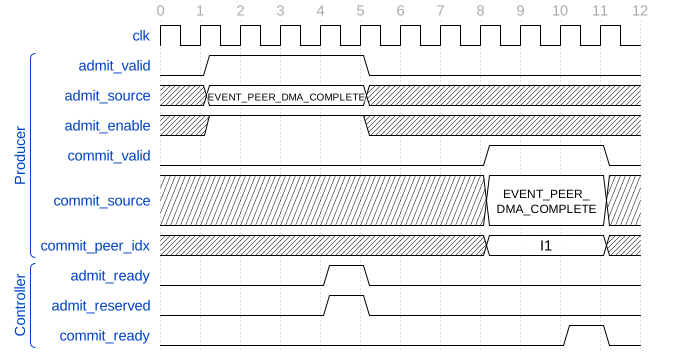
Delayed reserved commit with stable peer metadata under backpressure