Forwarding learning – openenoc_learning_if
Defines an Ethernet source-learning request and acknowledgement channel.
Source: openenoc_learning_if.sv.
Parameters
Name |
Default value |
Allowed values |
Description |
|---|---|---|---|
|
|
1..32 |
Port count and ingress-bitmap width. |
Connected interfaces must use the same bitmap width.
Signals
Directions are relative to the mst and slv modports.
Name |
Type |
Direction / role |
Description |
|---|---|---|---|
|
|
mst: output; slv: input |
Source-learning request strobe; one outstanding request per requester. |
|
|
mst: output; slv: input |
Source MAC address, captured with req. |
|
|
mst: output; slv: input |
Ingress-port bitmap captured with req; bit k identifies port k. |
|
|
mst: input; slv: output |
Completes the outstanding learning request; no response payload. |
Architecture and operation
Parameter and roles: NUM_OF_INTERFACES defaults to 8 and sets the
width of port_bitmap. Modports are mst and slv.
The requester presents a 48-bit source mac_addr and its ingress
port_bitmap with a one-cycle req pulse. The existing RTL
producers return req low on the following cycle and wait for ack
with req = 0. The requester may have one learning request outstanding.
The responder captures both payload fields on the low-to-high transition of
req. They need not remain stable after the request cycle. Keeping
them stable until acknowledgement is also valid. A request held through
acknowledgement is accepted as one transaction; another request requires a
new low-to-high transition. That acknowledgement refers to both payload
fields captured in the first active req cycle, even if their values
change while req stays high.
ack completes the learning transaction and carries no response payload.
In particular, port_bitmap travels with the request, whereas the bitmap
on Forwarding lookup – openenoc_lookup_if travels with the response. These interfaces have
separate request and acknowledgement signals. There is no request-ready or
response-ready signal.
Clock and reset belong to the connected modules. The interface contains signals and modports, with no clock/reset ports or internal storage.
Functional scenarios
The examples use NUM_OF_INTERFACES = 8. A0 and A1 denote
MAC addresses. Port bitmaps show all eight bits in port order [7:0]:
0b00000001 selects port 0 and 0b00000010 selects port 1. On the
learning channel, the MAC address is a source address and the bitmap
identifies its ingress port. Address labels are local to each diagram.
clk is the common clock of the connected logic, shown as a sampling
reference. Numbered cycles label intervals between rising edges; values are
sampled at each interval’s ending rising edge. Shaded x regions mark
irrelevant values, not a requirement to drive unknowns. The illustrated
completion latencies depend on the responder and are not an interface
guarantee.
Learning request with source address and ingress bitmap
In cycle 1, the requester pulses req with mac_addr = A0 and
port_bitmap = 0b00000001. The responder captures both fields at the end of
that cycle. req returns low in cycle 2, while the requester waits for
completion. This requester keeps both payload fields stable through the
acknowledgement, although only the request cycle needs them.
In cycle 3, the responder asserts ack. The requester samples that
completion at the cycle’s ending rising edge and may then issue another
learning request. There is no returned MAC address or bitmap to sample
with ack.
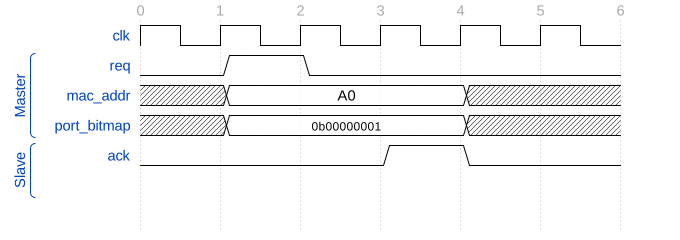
Learning request carrying source address and ingress bitmap
Request held until acknowledgement
The requester raises req with A0 and 0b00000001 in cycle 1 and
keeps it high through cycle 7. The responder captures that pair at the ending
rising edge of cycle 1, the first active request cycle.
In cycle 2, the requester changes the signals to A1 and 0b00000010
while req is still high. There is no new low-to-high transition,
so the changes do not create another request or modify the captured
A0/0b00000001 payload.
The responder asserts ack in cycle 7 for the original A0/0b00000001
request. It does not acknowledge the A1/0b00000010 values currently on the
signals. After sampling the completion, the requester deasserts req
in cycle 8. Another request requires a fresh low-to-high transition.
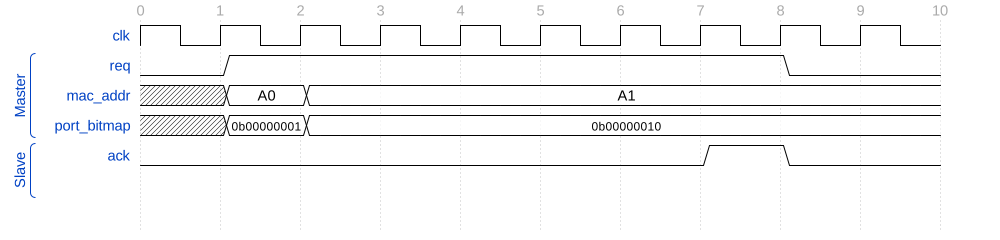
Held learning request acknowledged for its first-cycle payload
Independent operation alongside destination lookup
The learning and lookup channels may each have a request outstanding at the
same time. In cycle 1 below, a learning request carries source address
A1 and ingress bitmap 0b00000010, while a lookup request carries
destination address A0.
The lookup completes in cycle 3 with its own ack and returned bitmap
0b00000001. The learning request remains outstanding until its separate
ack in cycle 5. Acknowledgement on one channel does not complete the
other channel’s request. The shown completion order is illustrative.
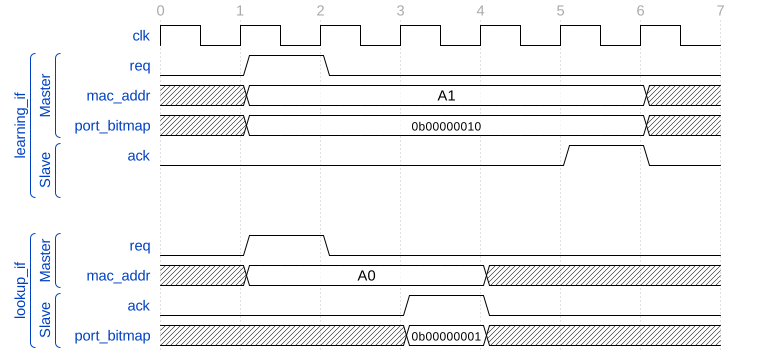
Independent learning and lookup request/acknowledgement channels