Endpoint peer lookup – openenoc_peer_lookup_if
Defines peer queries and coherent configuration responses for endpoint clients.
Source:
openenoc_peer_lookup_if.sv.
Parameters
Name |
Default value |
Allowed values |
Description |
|---|---|---|---|
|
|
Integer >= 1; match generated CSR array |
Number of peer-table entries. |
|
|
Integer >= 1; enough bits for the peer count |
Width of local peer indices; all connected interfaces must agree. |
|
|
Integer >= 1 |
Byte-address width in bits; connected interfaces must agree. |
Connected interfaces must agree on all three parameters. The current
Peer-table lookup – openenoc_endpoint_peer_lookup implementation requires ADDR_W = 32
to match the generated peer CSR fields.
Signals
Directions are relative to the mst and slv modports. The mon
modport observes all signals as inputs.
Name |
Type |
Direction / role |
Description |
|---|---|---|---|
|
|
mst: output; slv: input |
Request fields are valid and retained until accepted. |
|
|
mst: input; slv: output |
Accepts the request when req_valid is also asserted. |
|
|
mst: output; slv: input |
Lookup kind: index, RMEM address, or MAC address. |
|
|
mst: output; slv: input |
Eligible DMA-mode bitmap; zero permits no entry. |
|
|
mst: output; slv: input |
Peer index used only for LOOKUP_BY_INDEX. |
|
|
mst: output; slv: input |
Scalar-memory byte address used only for LOOKUP_BY_RMEM. |
|
|
mst: output; slv: input |
MAC address used only for LOOKUP_BY_MAC. |
|
|
mst: input; slv: output |
Response snapshot is valid and retained until accepted. |
|
|
mst: output; slv: input |
Accepts the response when rsp_valid is also asserted. |
|
|
mst: input; slv: output |
An eligible peer entry matched. |
|
|
mst: input; slv: output |
Matched peer entry index; zero on a miss. |
|
|
mst: input; slv: output |
Matched peer MAC address. |
|
|
mst: input; slv: output |
Matched virtual scalar-memory base/offset. |
|
|
mst: input; slv: output |
Matched local memory-window base. |
|
|
mst: input; slv: output |
Matched remote memory-window base. |
|
|
mst: input; slv: output |
Matched memory-window size in bytes. |
|
|
mst: input; slv: output |
Matched peer mode: disabled, RMEM, mirror-to-remote, or mirror-to-local. |
|
|
mst: input; slv: output |
Matched peer DMA event-enable setting. |
Architecture and operation
Parameters and roles: NUM_OF_PEERS defaults to 4; PEER_IDX_W is
derived with a minimum of one bit; ADDR_W defaults to 32. Modports are
mst, slv, and mon.
Request and response channels use independent ready/valid handshakes. A
request transfers on a rising edge with req_valid && req_ready; a
response transfers on a rising edge with rsp_valid && rsp_ready.
The master asserts req_valid when a request is available, without
waiting for req_ready. It retains the request and its meaningful fields
while req_valid && !req_ready. After acceptance, it may deassert
req_valid or present the next request. Keeping req_valid high does
not merge transfers: each edge with both request handshake signals high
accepts another request.
The slave retains rsp_valid and all response fields while
rsp_valid && !rsp_ready. The master samples the snapshot only when
both response handshake signals are high. Request acceptance and response
completion are separate events; neither a fixed response latency nor a
fixed number of outstanding requests is specified by the interface.
req_type selects LOOKUP_BY_INDEX (0), LOOKUP_BY_RMEM (1), or
LOOKUP_BY_MAC (2). Only the selected key, respectively req_peer_idx,
req_rmem_addr, or req_mac_addr, is meaningful. req_mode_mask[n]
permits entries whose dma.mode is n. A zero mask matches nothing; callers
normally leave bit zero clear, and the current lookup block also excludes
disabled entries.
Code |
Interface constant |
Selected key |
|---|---|---|
0 |
|
|
1 |
|
|
2 |
|
|
The interface defines DMA_MODE_DISABLED (0), DMA_MODE_RMEM (1),
DMA_MODE_MIRROR_TO_LOCAL (2), and DMA_MODE_MIRROR_TO_REMOTE (3) for
rsp_dma_mode and the mask bit indices. LOOKUP_RMEM_MODE_MASK selects
RMEM entries, LOOKUP_MIRROR_MODE_MASK selects both mirror modes, and
LOOKUP_ACTIVE_MODE_MASK combines all three active modes. The masks are
derived from the mode constants.
Code / mask bit |
Interface constant |
Meaning |
|---|---|---|
0 |
|
Disabled peer entry. |
1 |
|
Scalar RMEM address mapping. |
2 |
|
Bulk DMA copies remote memory into local memory. |
3 |
|
Bulk DMA copies local memory into remote memory. |
The response is a coherent snapshot: rsp_hit, rsp_peer_idx,
rsp_mac_addr, rsp_rmem_offset, rsp_local_addr, rsp_remote_addr,
rsp_size, rsp_dma_mode, and rsp_irq_enable. Entry fields are zero
on a miss. The implementation is Peer-table lookup – openenoc_endpoint_peer_lookup.
Clock and reset belong to the connected modules. The interface contains no clock/reset ports or internal storage.
Functional scenarios
The examples use NUM_OF_PEERS = 4 and ADDR_W = 32.
I0, I1, and I2 denote peer indices; A0, A1,
and subsequent A labels denote addresses. M0, M1, and
M2 denote mode masks; S0 and S1 denote window sizes.
Labels are local to each diagram.
clk is the common clock of the connected logic, shown as a sampling
reference. Numbered cycles label intervals between rising edges; transfers
occur at each interval’s ending rising edge when VALID and READY are both
high. Shaded x regions mark irrelevant values, not a requirement to
drive unknowns. The shown response latencies are illustrative.
Query by peer index, scalar address, or MAC address
Three requests use the same channel in sequence. The first presents
req_peer_idx = I0 with req_type = LOOKUP_BY_INDEX in cycle 1
and is accepted in cycle 2. Its response transfers in cycle 3 and contains
peer index I0 with configured MAC address A2.
The second presents scalar-memory address A0 with
req_type = LOOKUP_BY_RMEM in cycle 5 and is accepted in cycle 6.
Its response transfers in cycle 7 and identifies peer I1 with MAC
address A3. The third presents MAC address A1 with
req_type = LOOKUP_BY_MAC in cycle 9 and is accepted in cycle 10.
Its response transfers in cycle 11 and identifies peer I2 with
the same MAC address A1. Only the selected request key is meaningful.
All three requests select eligible entries, so rsp_hit = 1 with
each response. The mode masks are M0 = 0xC for modes 2/3,
M1 = 0x2 for mode 1, and M2 = 0xE for modes 1/2/3.
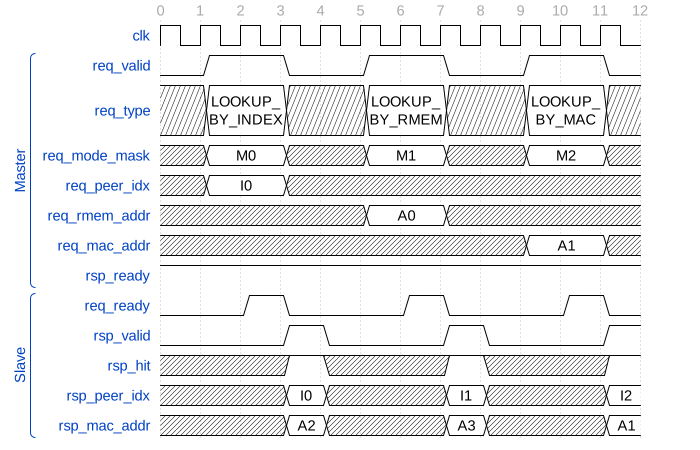
Peer queries selected by index, scalar address, and MAC address
Mode mask and response status
Assume MAC address A0 belongs to a single enabled peer I0
whose DMA mode is DMA_MODE_MIRROR_TO_LOCAL. Both requests use
LOOKUP_BY_MAC and the same address; only req_mode_mask differs.
The first request uses M0 = 0x4, permitting DMA_MODE_MIRROR_TO_LOCAL. It is accepted
in cycle 2, and its response transfers in cycle 3 with rsp_hit = 1,
rsp_peer_idx = I0, rsp_mac_addr = A0, and
rsp_dma_mode = DMA_MODE_MIRROR_TO_LOCAL.
The second request uses M1 = 0x2, permitting only DMA_MODE_RMEM, and is
accepted in cycle 6. Its response transfers in cycle 7 with
rsp_hit = 0 and all entry fields zero. This response uses the same
VALID/READY handshake and completes normally. The status bit describes the
returned snapshot; it does not suppress completion.
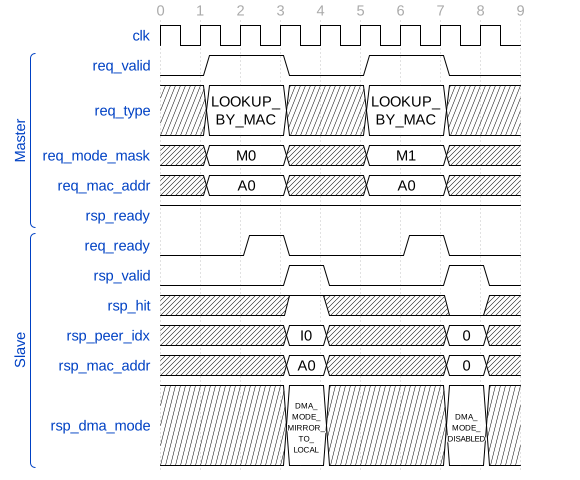
Mode masks carried with MAC queries and their response status
Request backpressure and retained response snapshot
The master presents an index query for I0 in cycle 1. With
req_ready = 0 in cycles 1 and 2, it keeps req_valid = 1,
the selected key, the lookup type, and M0 = 0x4 unchanged.
The request is accepted in cycle 3 when req_ready = 1.
The master deasserts req_valid in cycle 4.
The response becomes valid in cycle 4, while rsp_ready = 0.
Its entire snapshot remains stable through cycle 7, including
rsp_hit, the peer index, all addresses, the window size, DMA mode,
and IRQ enable. For example, a peer-configuration update in cycle 5 does
not replace this pending response. The master asserts rsp_ready
in cycle 7 and samples the original snapshot at the ending rising edge.
A new query for the same I0 is presented in cycle 9 and accepted
in cycle 10. Its response transfers in cycle 11 and reflects the updated
configuration: the address fields change from A0/A2/A4/A6 to
A1/A3/A5/A7, the size changes from S0 to S1, and
IRQ enable changes from 0 to 1. The peer index and DMA mode remain the same.
Each response therefore retains the entry captured for its accepted request.
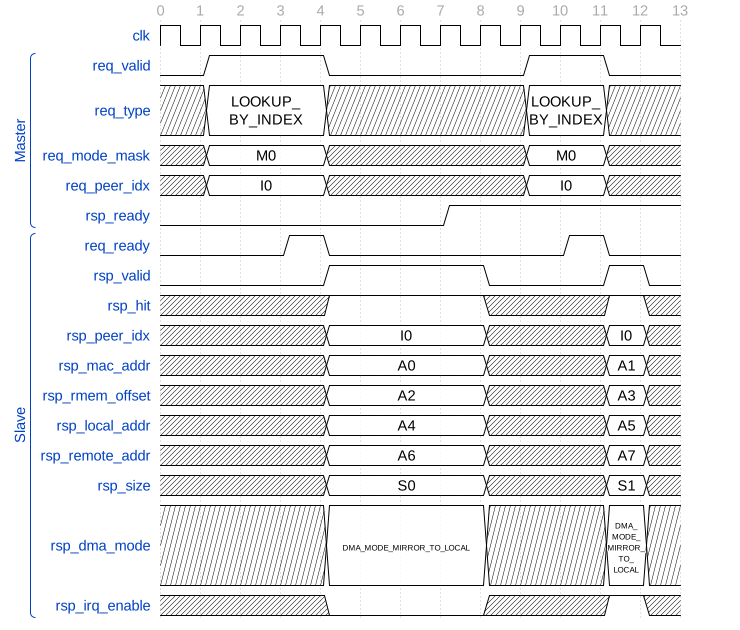
Request backpressure and a coherent response retained until acceptance