Crossbar elastic buffer – openenoc_axil_crossbar_skid_buffer
Provides an elastic pipeline boundary that absorbs delayed downstream backpressure.
Source: openenoc_axil_crossbar_skid_buffer.sv.
Parameters
Name |
Default value |
Allowed values |
Description |
|---|---|---|---|
|
|
Integer >= 1 |
Packed channel payload width in bits. |
Signals
Name |
Type |
Direction / role |
Description |
|---|---|---|---|
|
|
input |
Clock for this component or interface domain. |
|
|
input |
Active-high synchronous reset of VALID and READY state. |
|
|
input |
Packed upstream payload. |
|
|
input |
Upstream payload is valid. |
|
|
output |
Registered upstream acceptance indication. |
|
|
output |
Packed downstream payload. |
|
|
output |
Downstream payload is valid. |
|
|
input |
Downstream acceptance indication. |
Architecture and operation
This two-entry elastic register slice stores packed AXI4-Lite channel payloads
of DATA_W bits. The output payload and VALID, and the upstream READY,
are registered. With continuous readiness, a payload accepted in one interval
is presented downstream in the next, and both sides can transfer once per
cycle after the initial fill. Only VALID qualifies the payload.
When downstream READY falls, the already registered upstream READY can still accept one more payload. The second entry retains it while the output entry holds its older payload stable. Upstream READY then falls to prevent overflow. When downstream consumption resumes, the two stored entries can drain on consecutive edges. Upstream acceptance resumes after READY has been registered high again; the stored second entry covers that recovery interval.
Reset synchronously clears both VALID states and upstream READY. Payload registers are not cleared. Buffered transfers are discarded at the reset edge; the producer must coordinate reset rather than replaying an aborted transfer implicitly. After reset release, one edge is needed to restore READY.
Functional scenarios
The examples use DATA_W = 32 and symbolic payloads D0, D1, … .
A numbered tick is an interval ending at a rising sampling edge. Transfers
occur when the corresponding VALID and READY are high. x marks payloads
without VALID. Source payload and VALID remain stable while awaiting READY.
Startup and continuous transfers
RST is high in ticks 0 and 1. The source offers D0 from tick 2, after
reset is released. READY is still low in tick 2 and becomes high in tick 3.
The source then transfers D0 through D3 in ticks 3 through 6.
The downstream side transfers them in ticks 4 through 7, one per cycle.
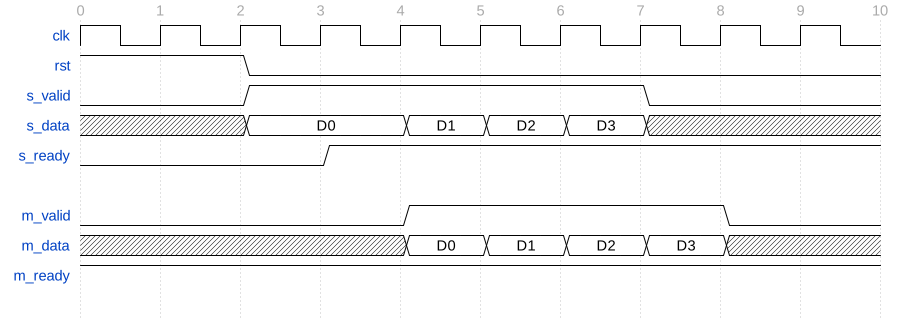
Registered readiness recovers after reset before continuous transfers
The second entry absorbs delayed backpressure
The source offers six payloads, D0 through D5. Downstream READY is
low in ticks 3 through 5. D0 has already transferred downstream in
tick 2; D1 is held at the output in ticks 3 through 6. The source can
still transfer D2 in tick 3 before its registered READY falls.
D3 waits at the input in ticks 4 through 6. When downstream READY rises
in tick 6, D1 transfers but upstream READY is still low. D2 follows
in tick 7 while the source finally transfers D3. Output transfers then
continue through D5 in tick 10 without another gap.
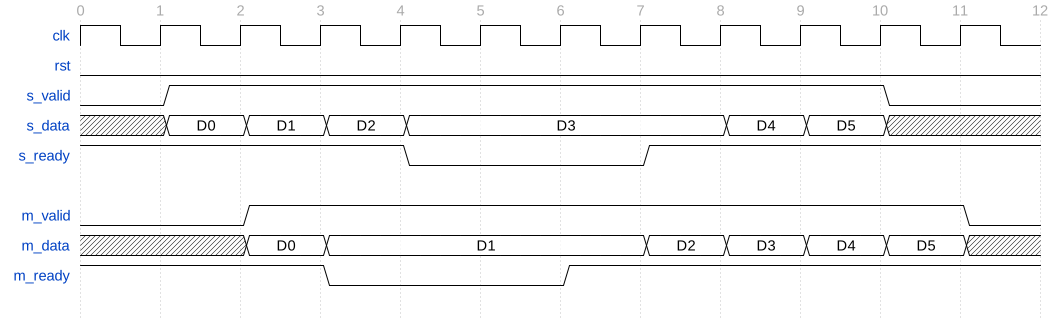
The second entry absorbs a transfer before upstream READY falls
Reset discards both retained payloads
With downstream READY low, the buffer accepts D0 and D1 in ticks
1 and 2. RST is asserted in ticks 3 and 4. The held output VALID is still
visible in tick 3 and clears at that interval’s ending edge. Neither stored
payload is delivered after reset.
The source offers new payload D2 from tick 5 after reset release.
READY recovers in tick 6, and D2 transfers downstream in tick 7.
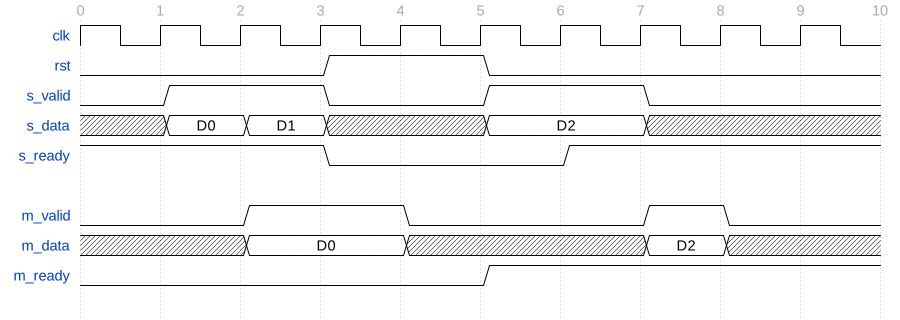
Reset discards held payloads and accepts new data after READY recovers