CPUIF to AXI4-Lite – openenoc_cpuif_axil_adapter
Converts native CPU register accesses into AXI4-Lite memory transactions.
Source: openenoc_cpuif_axil_adapter.sv.
Parameters
Name |
Default value |
Allowed values |
Description |
|---|---|---|---|
None |
— |
— |
This component has no elaboration parameters. |
Signals
Interface ports contain channels in both directions. The table identifies the selected modport or stream role; member directions follow that interface.
Name |
Type |
Direction / role |
Description |
|---|---|---|---|
|
|
input |
Common sampling clock for the CPUIF and AXI4-Lite interfaces. |
|
|
input |
Active-high synchronous reset of retained request state; immediately suppresses AXI VALID/READY outputs and CPUIF acknowledgements. |
|
|
bidirectional (slv) |
Native register-access slave accepting requests. |
|
|
bidirectional (wr_mst) |
Outgoing AXI4-Lite write channels. |
|
|
bidirectional (rd_mst) |
Outgoing AXI4-Lite read channels. |
Architecture and operation
s_cpuif is the native slave; m_axil_wr and m_axil_rd are AXI4-Lite
master views. Their address/data widths must agree. DATA width must be a
multiple of eight, with one AXI write strobe per byte. Addresses pass through
unchanged. AWPROT, ARPROT, and request USER fields are zero; response USER
fields do not affect native completion.
The adapter retains one active request and has no queue for additional native requests. The requester pulses REQ with the complete address, operation type, write data, and bit enables, then waits for the matching acknowledgement. A new request is accepted when idle or in the preceding operation’s acknowledgement interval. A REQ pulse earlier in an active operation is not buffered. Holding REQ through completion presents another request at that edge, so the requester must distinguish the old request from its successor.
An accepted request drives the corresponding AXI VALID and payload signals directly in its launch interval. If an AXI channel is not ready, the adapter stores the request and keeps that channel’s VALID and payload stable until its handshake. AW and W complete independently: accepting one does not withdraw the other, and an accepted channel is not sent again. AR follows the same retention rule for reads. Native request fields may change after the REQ interval without disturbing a stalled AXI transfer.
CPUIF write enables must be uniform within each byte to preserve their
meaning across this boundary. Each WSTRB bit is the reduction AND of the
corresponding eight wr_biten bits. A fully enabled byte produces one;
a fully disabled byte produces zero. A partially enabled byte also produces
zero, and the adapter does not report an error for that conversion.
Arbitrary per-bit masks therefore require a different access mechanism.
Once the active request has been registered, BREADY is high for a write or RREADY is high for a read. The selected READY remains high even while an address or write-data channel is stalled. The AXI target supplies a response only after accepting the required request channels.
For an active write, BVALID produces wr_ack in the same interval as the
B handshake. For an active read, RVALID produces rd_ack in the same
interval as the R handshake, with rd_data taken directly from RDATA.
There is no extra registered response stage or response FIFO. OKAY
(0b00) gives ERR zero; any nonzero BRESP or RRESP gives the matching
native ERR together with ACK. ACK is not conditional on the current REQ
level. Native read data is meaningful only with rd_ack.
If the requester presents the next request with that acknowledgement, its AXI request channels can handshake at the same edge as the old response. The old response still completes the old native operation; the newly launched request becomes active after that edge. Its response READY is then selected according to its own operation type.
Asserting rst immediately lowers AWVALID, WVALID, ARVALID, BREADY,
RREADY, and both native ACK/ERR pairs. The next rising edge clears the
retained request and pending channels. Reset can thus withdraw a stalled
channel without returning a completion for the cancelled native request.
The connected AXI target must also discard any part of that aborted access
before new traffic resumes.
Functional scenarios
The examples use 32-bit addresses and data with four AXI byte strobes.
A numbered tick denotes a clock interval. Native request sampling,
AXI handshakes, and native completion occur at its ending rising edge.
x marks fields that are irrelevant without REQ, VALID, or ACK.
Labels A0, A1, … denote byte addresses, D0, D1, … denote
data words, and M0/M1 denote native bit masks. Labels are local
to each scenario. Native payload fields change after each REQ pulse;
the stalled AXI channels retain the captured values.
Byte-enabled writes with independent AW and W acceptance
Access |
Native request |
AXI request acceptance |
Completion |
|---|---|---|---|
|
REQ pulse in tick 1 |
W in tick 1; AW in tick 4 |
B/OKAY and native write ACK in tick 5 |
|
REQ pulse in tick 7 |
AW in tick 7; W in tick 10 |
B/OKAY and native write ACK in tick 11 |
For the first write, M0 = 0x00FF00FF enables bytes 0 and 2 and becomes
S0 = 0b0101 on WSTRB. WREADY is high when REQ arrives in tick 1, so
D0 and S0 transfer immediately. AWREADY remains low through tick 3.
AWVALID stays high with A0 until its tick-4 handshake, even though
native REQ has already returned low. WVALID drops after tick 1 because the
data has been accepted. The successful B response in tick 5 produces
wr_ack = 1 and wr_err = 0 in that same interval.
The second write reverses the acceptance order. M1 = 0xFFFFFFFF becomes
S1 = 0b1111. AW transfers in tick 7, while WVALID holds D1 and
S1 through the W handshake in tick 10. AWVALID stays low after its
earlier acceptance. The read channels remain idle for both writes.
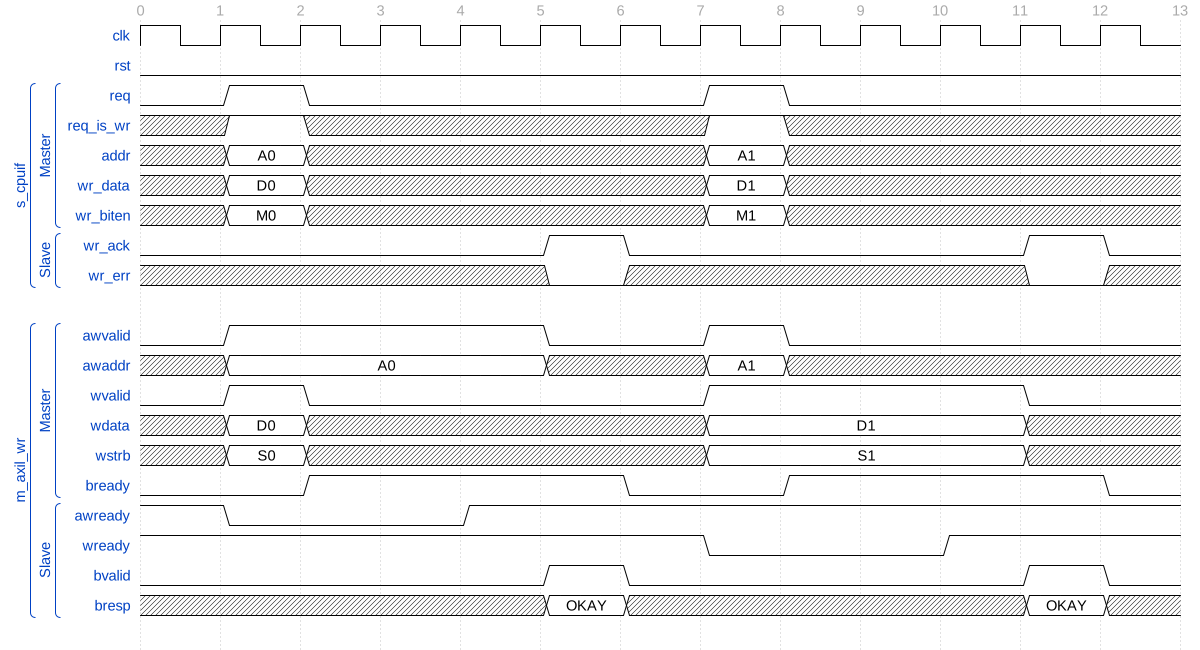
Write address and data remain pending independently until accepted
Read address stalls and overlapping completion
All AXI write byte strobes are enabled in this example.
Access |
Native REQ |
AXI request accepted |
AXI response and native completion |
|---|---|---|---|
Read |
Tick 1 |
AR in tick 3 |
R/OKAY with |
Write |
Tick 5, with the old read ACK |
AW and W in tick 5 |
B/SLVERR in tick 7 |
Read |
Tick 7, with the old write ACK |
AR in tick 7 |
R/DECERR with |
The read REQ in tick 1 raises ARVALID immediately, but ARREADY is low in
ticks 1 and 2. ARADDR remains A0 until the handshake in tick 3.
In tick 5, RVALID returns D0 and produces rd_ack without an extra
clock interval. The simultaneous new REQ describes write A1 / D1;
its AW and W channels transfer at the same edge as the old R response.
D0 still belongs to A0.
The write response in tick 7 has SLVERR (0b10), so wr_ack and
wr_err rise together. The next read A2 launches and its AR channel
transfers in that same interval. In tick 9, DECERR (0b11) produces
rd_ack = rd_err = 1 with rd_data = D2. The response codes affect
the native error flags without delaying acknowledgement or changing the
association between a request and its data.
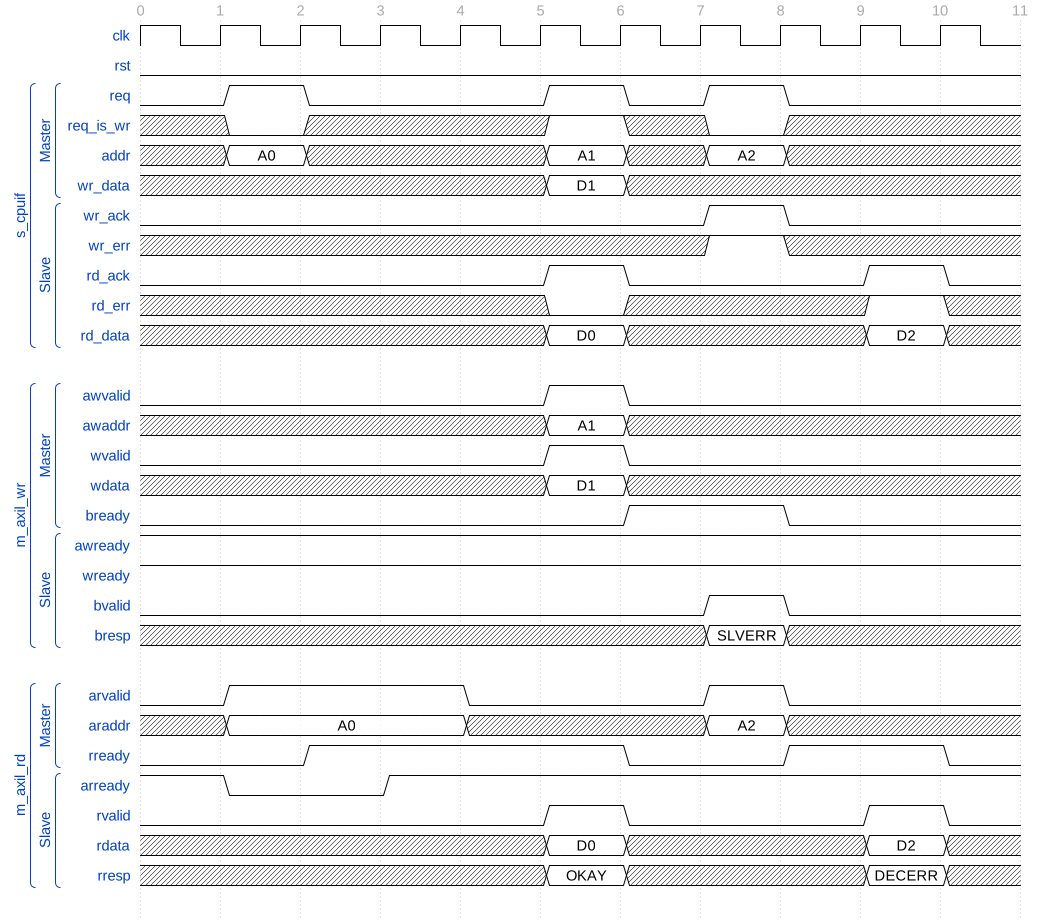
Old responses complete while the next native request launches
Reset cancels a partially accepted write
The AXI target is reset with the adapter and discards the partially accepted old write. All write byte strobes are enabled.
Access |
Request acceptance |
Result |
|---|---|---|
Write |
AW accepted in tick 1; W waits in ticks 1 and 2 |
Reset cancels the write without native ACK |
Read |
REQ and AR accepted in tick 5 |
|
Write |
REQ, AW, and W accepted in tick 7 |
Successful write ACK in tick 8 |
RST is high in ticks 3 and 4. WVALID drops immediately in tick 3, so the
previously held D0 cannot transfer even though WREADY is now high.
All request VALID and response READY outputs, and both native ACK/ERR pairs,
remain low during reset. The pending write state is cleared at the first
reset sampling edge.
After reset, read A1 is accepted in tick 5 and completes in tick 6.
Write A2 follows in tick 7 and completes in tick 8. No old address or
write data is replayed after reset, and no completion is fabricated for
the cancelled A0 write.
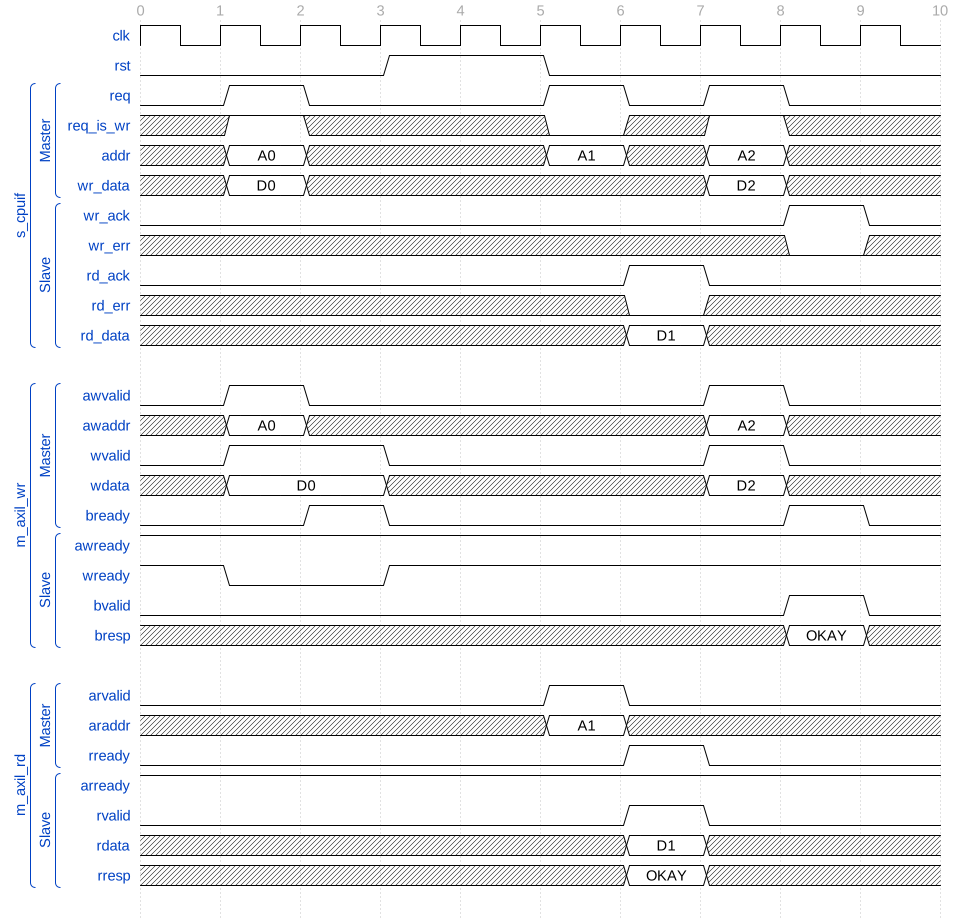
Reset cancels pending write data before new accesses begin
Verification
The test suite is in dv/core/openenoc_cpuif_axil_adapter/.
Testbench
This cocotb suite verifies openenoc_cpuif_axil_adapter in isolation with native CPUIF and
AXI4-Lite bus fixtures. The default fixture uses 32-bit addresses and data.
Coverage
The suite covers:
independent AXI write-address and write-data handshakes;
write-data acceptance before write-address acceptance;
stable AXI addresses and write payloads while stalled;
CPUIF bit-enable to AXI byte-strobe conversion;
AXI read-data delivery to CPUIF;
propagation of AXI read and write response errors;
one-cycle CPUIF acknowledgement strobes;
simultaneous completion of one request and launch of the next request;
bubble-free read-to-write handoff;
suppression of AXI transfers and CPUIF acknowledgements during reset; and
clearing a stalled transaction on reset.